To decide the right selling price for your used car, do not start with a number — finish with one. On your AutoKnowMus Seller dashboard, the AutoKnowMus Verdict sits near the bottom on purpose: it pulls together everything above it into seven short lines. It tells you how sure the estimate is and how many verified real deals sit behind it, what helps or hurts your own car, whether your papers will defend your price, what the price you have picked on the slider means in demand and days to sell, how easy cars like yours are to find, what waiting will cost you, and three price lanes — Cash-fast, Balanced and Premium ask — inside your fair range. Move the slider and the Verdict rewrites itself. Read every panel above it first, pick the lane that fits your date, and then read the Verdict last. It is the summary, not the shortcut.
What this post covers
This is the last post in the series. Why the Verdict sits at the bottom of your Seller dashboard, and why you should read it last. What each of its seven lines tells you, and how they change when you move the price slider. The three price lanes, and how to pick yours. The whole Seller dashboard from top to bottom — eleven panels, eleven questions, one Verdict. The seven ways Sellers misread it. And a Before-You-Sell Brief near the end that puts your whole plan on one card you can send to your family. If you have not read them yet, sold is not done sits right before this one, and what waiting costs you is where this series began.
It is Saturday morning. 7:10.
The tea is still too hot to drink. Your phone is already open.
Last night your brother-in-law asked the question everyone asks: "So what will you get for the car?"
You said, "Let me check properly."
So here you are. You type in your car's details. The dashboard opens. A big number sits at the top. A range. A slider. Some cards with words like demand and days to sell. A chart. A list of photos to take. And far down, at the bottom, a dark green box with the word Verdict.
You do what everyone does. You look at the big number, take a screenshot, and send it to the family group.
"Dashboard says this much."
Ten minutes later, your brother-in-law replies: "Ask for more. Dealers always cut."
Your cousin replies: "Mine sold in two days for less. Don't be greedy."
And now you are back where you started. Three opinions. One number nobody trusts. And a car that loses a little value every week you spend deciding.
Here is what nobody told you: you sent the wrong screenshot.
The judge speaks last
I have been in this trade a long time. I have watched thousands of cars change hands. And I have noticed one thing about the Sellers who do well.
They do not jump to the number. They read the whole case first.
Think of a courtroom. The judge does not walk in and announce the verdict. First the witnesses speak. The evidence goes on the table. Each side says its piece. Only then, at the very end, does the judge speak — and the verdict means something because of everything heard before it.
Your Seller dashboard is built the same way.
Every panel above the Verdict is a witness. One tells you the fair range. One tells you what pushed it up or down. One tells you whether Buyers are looking. One tells you how your car compares. One tells you which way prices are moving. And the AutoKnowMus Verdict, at the bottom, is the judge — it listens to all of them and says it in plain words.
That is why it sits at the bottom. And that is why you should read it last.
Read it first, and it is just more words under a number. Read it last, and every line clicks into place — because you have already seen the evidence for it.
Reading it last pays you, not just your patience. Here is how.
1. You price once, not three times. Sellers who jump to the number usually change their price twice in the first fortnight — once after a lowball call, once after a cousin's story. Read the case first, and your first price is one you can hold.
2. You see the cost of waiting before you pay it. The Verdict puts a figure on what a month, or three months, of waiting takes from your car. You decide with that figure in front of you, not after it has already gone.
3. You know what the Buyer will push on before the phone rings. High kilometers, a missing service bill, a car that is easy to find — the Verdict names them first, so the Buyer's argument is not news to you.
4. You end the family debate. "Ask for more" and "don't be greedy" are both opinions. A lane, a date and the reasons behind them are a plan. Plans end arguments.
5. Your price fits your life. The lane you pick is chosen by your date and your car, so the sale lands when you need the money — not three months after the new car arrived.
So before we walk the whole dashboard, let us open the Verdict itself and read it line by line.
A blood report, not a thermometer
A thermometer gives you one number. A blood report gives you twenty, and then a doctor writes three lines at the bottom: what is fine, what to watch, what to do next. Nobody reads only the first number on a blood report. The AutoKnowMus Verdict is those three lines at the bottom — for your car.
What the Verdict says, line by line
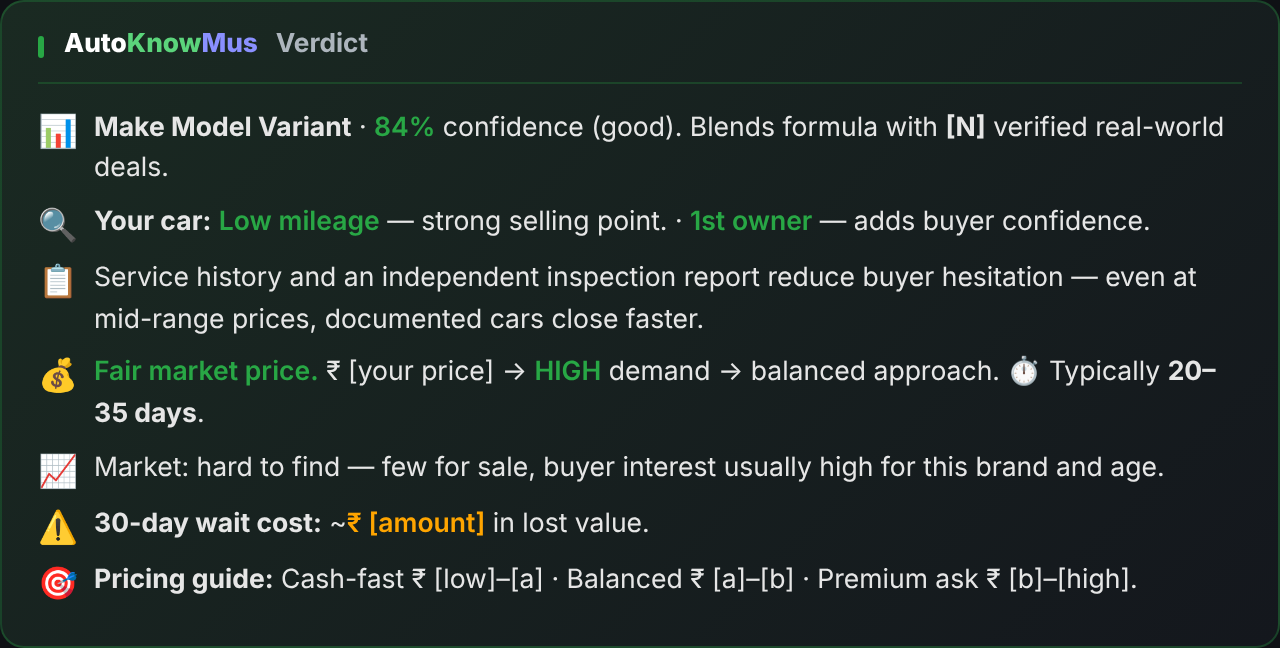
The AutoKnowMus Verdict, shown with sample details. Your own Verdict shows your car's name and real figures in place of the brackets.
The Verdict is short on purpose. Each line starts with an icon, so your eye can find it again in two seconds. Here is what each one tells you, and what to do with it.
📊 Line one — how sure the estimate is. Your car's name, and a confidence figure in green. If verified real deals have been reported for cars like yours, the line says how many the estimate is blended with. If none have been reported yet, it says so honestly: the estimate is based on the pricing model while verified deal data is still being collected. What to do with it: a high confidence with real deals behind it means you can stand firm on the range. A lower one means the range is still a strong guide — but your own checks (the panels above) matter more.
🔍 Line two — your car, in one breath. This is where the Verdict talks about your car, not cars in general. Excellent condition, low kilometers and a first owner show up here in green, because they are selling points. Fair condition or high kilometers show up in amber or red, because a Buyer will raise them. What to do with it: every green word goes into your ad and your first WhatsApp reply. Every amber word is a question you should answer before the Buyer asks it.
📋 Line three — your papers. When your car's estimate sits high in its fair range, this line tells you plainly that Buyers paying more expect proof: a verified service history and an independent inspection report. Otherwise, it reminds you that documented cars close faster at any price. What to do with it: a file of bills is the simplest way to defend your price. Gather it before your ad goes up, not after the first lowball call.
💰 Line four — the price you picked, and what it means. This line answers the slider. It names where your price sits — a quick sale price, a fair market price, or the top of the range — with the demand level for your car and the usual time to sell it, such as "under 20 days" or "35–60 days". What to do with it: this is the line that changes as you drag the slider. Watch it. It is the most honest conversation you will ever have about your own price.
📈 Line five — the market for cars like yours. When AutoKnowMus can rank how many cars like yours are for sale, this line tells you: hard to find, easy to find, or somewhere in between. What to do with it: if yours is hard to find, you do not need to be the first to blink. If it is easy to find, the Buyer has choices — your photos, your papers and your speed of reply matter more.
⚠️ Line six — what waiting will cost. Price near the bottom of the range, and this line says the waiting cost is minimal — you will likely sell before the car loses much. In the middle, it shows roughly what a 30-day wait costs in lost value. Near the top, it shows the 90-day cost and warns that a faster sale may net you more overall. What to do with it: put this number next to the extra you hope to get by holding out. If the wait costs more than the extra, holding out is a loss dressed up as patience.
🎯 Line seven — the pricing guide. The last line splits your fair range into three lanes: Cash-fast, Balanced and Premium ask, each with its own range. What to do with it: pick one lane — not one number — and price inside it. That is your decision, made with the whole case in front of you.
Seven lines. Under a minute to read. But each one is standing on a panel you have already seen.
Drag the slider. Watch the Verdict change.
Most Sellers miss this. The Verdict is not a fixed paragraph. It listens to the price slider in the Price strategy box.
Slide toward the bottom of the range, and line four says quick sale price, the days to sell drop, and line six says waiting will cost you very little.
Slide to the middle, and it says fair market price, balanced approach, and puts a rough figure on what a month of waiting costs.
Slide to the top, and the words turn amber. Top of range. Longer wait, top value. The waiting cost jumps to the 90-day figure, with a warning that a faster sale may net you more overall.
You are not reading a verdict. You are having a conversation with it. Every price you try, it answers back: here is what this price will ask of you.
That is the real gift. Not a number — a trade-off you can see before you commit to it.
Have a date? Let the date pick the price.
Right under the slider, "When do you need to sell?" works both ways. Pick your sell-by date and the slider jumps to a price that usually sells in that time. Drag the slider and it shows the date that price usually sells by. Then read the Verdict again — it now speaks for your date, not for a wish. That is the whole idea of selling to a date, not to a price.
Three lanes. Pick one.
Every car sale is a pull between three things. How much you get. How fast it happens. How much effort it takes along the way.
You can usually have two. Rarely all three.
The three lanes on the Verdict's last line are those choices, made plain.
All three lanes sit inside your fair range. None of them is wrong. Each one asks something different of you.
Cash-fast is for the Seller with a date: a transfer next month, a new car arriving on Friday, a loan to close. You give up a slice of the price, and in return the car sells soonest and stops losing value.
Balanced is for most Sellers. A fair price, the usual time, normal effort. If you have no date and no reason to rush, start here.
Premium ask is for the car that has earned it — excellent condition, low kilometers, full papers, great photos — and a Seller who can afford to wait. You may get the top of the range. You will also pay for the wait, and you will need everything that line three asks for.
Here is the rule I have watched work for years: the lane is chosen by your life, not by your pride. If your date is close, the Premium ask lane is not ambition. It is a trap.
The whole dashboard, top to bottom
Now let us walk the whole case, the way the judge hears it. Eleven panels sit above or beside the Verdict. Each one answers one question a careful Seller asks. Each one had its own post in this series.
Eleven questions, in screen order
1. What does waiting cost me? The value line and the 90-day chart — your car loses a little every week, even parked. Read #01.
2. When do I need to sell? "When do you need to sell?" under the price slider — pick a date, see a price. Read #02.
3. Where did this number come from? The estimated fair market value and "How this estimate is built". Read #03.
4. What pushed it up or down? "What affects your price range?" — owners, condition, kilometers, age and fuel, each marked Adds value, Neutral or Reduces value. Read #04.
5. Are Buyers even looking? Market Indicators — demand, days to sell and listing scarcity. Read #05.
6. How does my car compare? "Your car vs the market". Read #06.
7. Which way are prices moving? The price trend. Read #07.
8. What do I say when the Buyer calls? Your ready-to-post listing and the facts to negotiate with. Read #08.
9. What makes the phone ring? "How to photograph your car — the 9 shots that sell". Read #09.
10. What are cars like mine actually selling for? Seller deal alerts. Read #10.
11. What do I do after the handshake? "Was this estimate helpful?" and Submit a verified deal. Read #11.
12. So — what should I do? The AutoKnowMus Verdict. You are reading it.
Notice something. Every line of the Verdict is the short version of a panel above it.
Confidence comes from how the estimate is built. Your car comes from what affects your price. Demand and days come from the market indicators. The market line comes from listing scarcity. The waiting cost comes from the value chart. The lanes come from the fair range itself.
The Verdict does not invent anything new. It summarises. That is exactly why reading it alone, without the panels, is like reading the last page of a mystery novel and wondering why everyone is so surprised.
Six questions the Verdict answers — if you let it
Strip any car sale down and only six questions are left. A good Verdict answers all six.
What is it worth? Your fair range, and how sure we are of it.
Why that much? The things about your car that add value, and the ones that take it away.
Who will buy it? How many Buyers are looking, and how many other cars they can choose from.
When should it go? How long your chosen price usually takes, and what each week of waiting costs.
Where does it stand? Hard to find, easy to find, or in the middle of the pack.
How do you sell it? Pick a lane, prepare the papers, take the photos, post the listing, answer fast.
If you finish your dashboard and you cannot answer all six in one sentence each, you are not ready to put a price on WhatsApp yet. Scroll up. The missing answer is in one of the panels.
Six of the seven are in your hands
Here is the part that should give you courage.
Seven things decide how your sale goes. Six of them belong to you.
You — how quickly you reply, how calmly you negotiate, how honest your ad is.
The car — clean it, fix the small things, and the "Your car" line turns greener.
The papers — the RC, insurance, service bills, the inspection report. Line three asks for them by name.
The method — where you post, how you reply, which lane you choose.
The measurement — the fair range itself, worked out from the car's facts, not a guess.
The plan — a date, a lane, a lowest price written down before the first call.
The seventh is the market — demand, how many cars like yours are for sale, which way prices are moving. You cannot change it. But the Verdict tells you exactly what it is doing, so it never surprises you.
Six of seven in your hands. Most Sellers spend all their worry on the seventh.
Six things every good asking price has
Proof — it comes from the car's own facts, not from a wish. Papers — a service history and, higher in the range, an inspection report to defend it. Photos — the nine shots that let a Buyer believe it before they visit. Pace — a quick, calm reply to every serious call. Plan — a lane and a date, chosen before the ad goes up. Patience, with a limit — you know what each week of waiting costs, so you know when to stop holding out.
Never send just the top number to the family group
The top of your dashboard is the start of the case, not the end of it. A single number invites a single reaction: "ask for more" or "you'll never get that". Send the lane you chose, your date and the reasons — the Before-You-Sell Brief below does it in one tap — and the conversation changes from opinions to a plan.
Seven ways Sellers misread the Verdict
I see these every week. Each one costs real money.
1. Reading it first. Without the panels above it, the Verdict is a set of claims with no evidence. Read it last, and every line has its proof sitting right above it.
2. Reading it once. The Verdict changes with the slider. If you looked once at the starting position and closed the page, you read one sentence of a conversation.
3. Treating the top of the range as the price. The top of the range is a lane, not a promise. Line four turns amber there for a reason.
4. Ignoring the waiting cost. Holding out for a little more, for months, often ends with less. Line six puts a figure on it. Believe it.
5. Skipping the papers line. If you price high and have no service history, the Buyer will use that gap to pull you down. Line three is warning you before they do. Missing the booklet? You can rebuild the service history, step by step.
6. Picking a lane by pride. "My car is special" is not a lane. Your date, your car's condition and your papers choose the lane. Your feelings do not.
7. Forgetting the Verdict after the sale. The first line counts verified real deals. Yours can be one of them. When the car is sold, report the price — it pays you in Credits and makes the next Verdict sharper. That was #11.
Avoid these seven, and you are already ahead of most Sellers on the road.
Your Before-You-Sell Brief
You have read the case. Now put your decision on one card.
Fill in what your Seller dashboard told you, and the brief turns it into a short plan — your lane, your date, how many days you have, and what is still missing. Copy it and send it to your family group instead of a screenshot of one number.
Before-You-Sell Brief
Fill it in with your Seller dashboard open beside it. Nothing is uploaded or saved by AutoKnowMus.
What your dashboard told you
Your plan
Ready before your ad goes up
Make my brief turns your answers into a short plan below. Copy brief copies it as plain text, ready to paste into WhatsApp. Start over clears every field, dropdown and tick.
Open my Seller dashboard takes you to AutoKnowMus to check your car's fair range and read your own Verdict. Already sold? takes you to "Just bought or sold a used car?" at the bottom of this page, a quick price check that also records your deal.
The brief is a planning aid, not a price. It cannot tell you what your car is worth — your Seller dashboard does that.
The short version
| Before you price your car | Do this | Not this |
|---|---|---|
| The order | Read every panel, then the Verdict last | Jump to the top number |
| The slider | Drag it and watch the Verdict change | Read the Verdict once |
| Your date | Let "When do you need to sell?" pick the price | Pick a price, then hope |
| The lane | Choose Cash-fast, Balanced or Premium ask | Choose one number by pride |
| The waiting cost | Weigh it against the extra you hope for | Ignore it |
| Your papers | Gather them before the ad goes up | Hunt for them after the first lowball call |
| The family group | Send the brief — lane, date, reasons | Send a screenshot of one number |
| After the sale | Report the price | Keep it to yourself |
One line holds the whole table together: the number at the top starts the conversation; the Verdict at the bottom finishes it — read them in that order, and you sell with your eyes open.
Why this matters to us at AutoKnowMus
Twelve posts ago, we started with one idea: most Sellers lose money not because they are careless, but because they decide with half the picture. A number from a friend. A wish from an ad. A lowball call at the wrong moment.
We built AutoKnowMus to put the whole picture on one screen — one fair range, the same figure for the Seller and the Buyer, worked out from the car's own facts: make, model, year, variant, owners, kilometers and condition, and blended with verified real deals as they are reported. Here is how we work it out. The Verdict is that picture in seven lines.
We do not buy cars. We do not sell them. We do not list them. Not one rupee of ours moves when your deal closes, whatever price it closes at. The verdict is never for sale.
Read the whole case. Then read the Verdict. Then sell like you knew all along.
FAQs
How do I decide the right selling price for my used car?
What is the AutoKnowMus Verdict?
Why does the Verdict change when I move the price slider?
What do Cash-fast, Balanced and Premium ask mean?
How long does it take to sell a used car?
How do I price my used car for a quick sale?
What does the confidence figure in the Verdict mean?
Should I price my car at the top of the range?
Does AutoKnowMus buy or sell cars?
You have read all twelve. Now read your own. Open your Seller dashboard, walk it from top to bottom, drag the slider, and read the Verdict last.
That is the end of "Don't Sell Your Car Until You've Done These 12 Things".
Next — a new series. Next Saturday we cross to the other side of the handshake: the Buyer.