Quick answer
Before a buyer ever calls you, they have already compared your car with every similar car for sale. Two things decide how yours looks in that comparison: how many similar cars are for sale, and how much interest buyers usually have in cars like it. Being rare helps only when people are looking. Your kilometers are judged against the other cars for sale, not against a general rule. The "Your car vs the market" panel on your Seller dashboard shows you both, so you can see your car the way the buyer already does.
Every seller thinks about their own car. Almost no seller thinks about the other cars. The buyer thinks about almost nothing else. By the time they reach your door, they have looked at every similar car for sale, checked the kilometers on each one, and put yours somewhere in that order. You are about to be judged in a comparison you have never seen. This post shows it to you.
📍 What this post covers
The three things a buyer measures when they compare cars. Why "how many are for sale" and "how much buyer interest there is" are two different facts. What each of the six labels on your panel means. How your kilometers look next to the competition, which is different from how they look next to your car's age. And seven ways sellers misread where their car stands. If you haven't read them yet, #04, what is lifting your price and what is dragging it down and #05, are buyers looking for your car come just before this one.
I have heard one sentence from sellers more times than I can count.
"You won't find many cars like mine."
It is always said with pride. And it is usually true.
Two sellers said it to me in the same month. Same sentence. Same pride. Both were telling the truth.
The first car was gone in a few days. A buyer had been searching for exactly that car, and was glad to find it.
The second car stayed. Week after week. The reason you didn't see many of them was very simple: not many people wanted one.
Same words. Same truth. Opposite endings.
The difference was not luck. It was not the car's colour, or the seller's manners, or the weather. The difference was that one seller had the kind of rare that people search for, and the other had the kind of rare that people scroll past. Neither of them knew which kind they had.
By the end of this post, you will know which kind you have.
The buyer has already met your competition
Here is the truth that almost nobody tells a first-time seller.
A buyer never looks at your car alone. They look at your car, and in their mind, next to it stand every other car like it that they found for sale.
When they compare, they are asking three questions. Every buyer asks them. Most never say them out loud.
How good is it? Next to the others, is this one in better shape or worse? Has it been driven more or less?
What else could this money buy? A buyer with a fixed budget is not choosing only between cars of your model. They are choosing between everything that money can buy. Your car competes with all of it.
How easy is it to get another one? If there are plenty more like it, the buyer can walk away and try the next one. If there aren't, they can't.
Quality. Cost. Availability. Every buying decision in the world comes down to those three, and a used car is no exception.
Your AutoKnowMus Seller dashboard already answers the second question, the money, with your estimated range. This post is about the other two. The "Your car vs the market" panel shows you how easy your car is to find and how far it has been driven next to the others.
It never shows you a rupee figure. You will see why before the end.
Two questions, not one
Think of flats in one housing society.
Count how many flats in that society are for sale right now. That is one fact.
Now count how many people are asking to buy a flat there. That is a second fact.
Everyone needs a home. But nobody needs a home in that particular society. People choose it because they like the location, the building, the neighbours, or they don't. A car is the same kind of choice.
Say only two flats in the society are for sale. That can mean two very different things. Either people love living there, so flats rarely come up for sale and go quickly when they do. Or people don't want to live there, so the few that come up stay for sale for months. Same two flats. Opposite stories. And you cannot tell which one it is just by counting the flats.
Most sellers only count the flats. They search online, see only a few cars like theirs, and stop there. "There are hardly any. Mine must be special."
Don't stop there. Ask both questions.
Question 1: How many are for sale? How many cars like yours have been for sale recently, compared with other cars at the same price. That last part matters. Your car is not being measured against its own model alone. It is measured against everything a buyer could buy with the same money.
Question 2: How much buyer interest is there? AutoKnowMus estimates this from how sought-after the brand is and how old the car is. It is not a count of people searching this week. It is what usually holds for cars of that brand and age, and the panel says so in its own words: "usually … for this brand and age."
These two facts move separately. A car can be hard to find and much wanted. It can be hard to find and hardly wanted. It can be easy to find and still wanted by many. The panel puts both answers together and gives you one simple word for where your car sits.
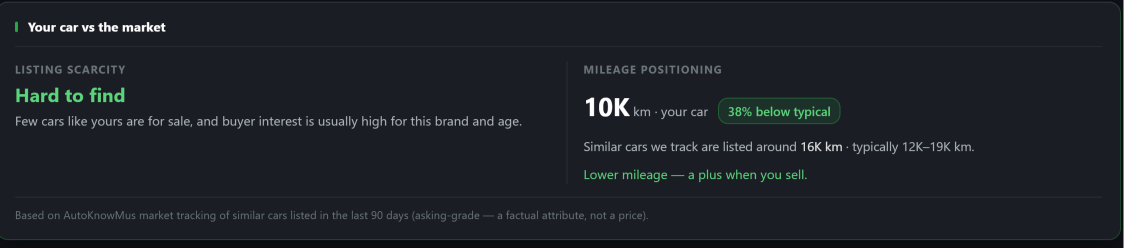
Few similar cars for sale, buyer interest usually high for this brand and age, and a reading well below typical. One car's screen — yours will look different.
Rare only helps when someone is looking
Here is the biggest idea in this post. Read it twice.
Being rare is worth something only when someone is looking for it.
Think of an old postage stamp. It may be one of only a few left in the world. To a collector who wants it, it is a treasure. To everyone else, it is a small piece of paper with a picture on it.
Cars work the same way. A rare car with buyers searching for it is in a strong position. A rare car that nobody is searching for is just a car that nobody is searching for.
That is exactly why the panel has a label called Rarely sold. It means two things together: few cars like yours are for sale, and buyer interest is usually low for cars of that brand and age. Being rare does not push the price up when few people are asking.
In this trade, this is the most common mistake I see. A seller finds only two or three cars like theirs for sale and thinks, "I can ask more." Sometimes the market agrees. Sometimes the market is saying the opposite, and saying it clearly.
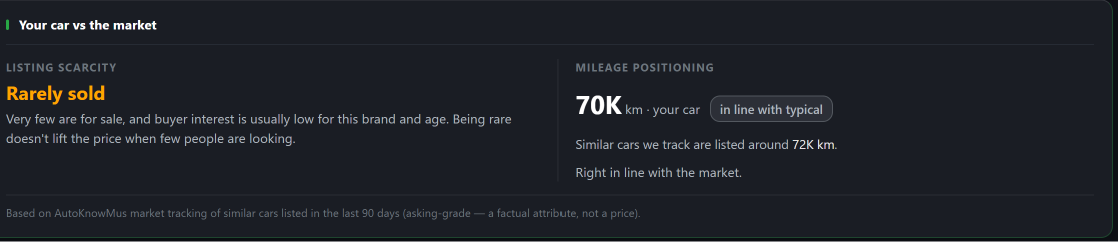
Few for sale, and buyer interest usually low for this brand and age: rare, but not in demand. One car's screen — yours will look different.
Here are all six labels, in three groups:
| How many similar cars are for sale | Labels you may see |
|---|---|
| Fewer than most cars at the same price | Hard to find (interest usually high) · Uncommon (usually average) · Rarely sold (usually low) |
| About as many as most cars at the same price | Fairly common (no claim about interest) |
| More than most cars at the same price | Easy to find (usually at least average) · Lots for sale (usually low) |
In the first and last groups, the label also carries the buyer interest AutoKnowMus estimates for that brand and age. That is why "Hard to find" and "Rarely sold" can both describe a car with only a few like it for sale, and still tell you two very different stories. "Fairly common" describes supply only. And for a brand where we can't estimate interest, the panel says nothing about buyers at all: you see only "Hard to find" or "Easy to find," describing supply.
And if your label is Fairly common or Lots for sale? That is not bad news. It means buyers already know your kind of car. They know what to expect from it and roughly what it should cost. Your car is simply being compared with more cars. So how it compares, especially on kilometers, matters even more. That is the next section.
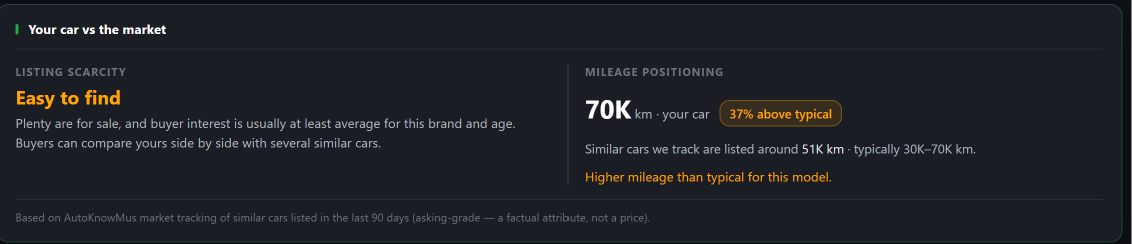
Plenty for sale, and buyer interest usually at least average for this brand and age. One car's screen — yours will look different.
🟢 Stop here for thirty seconds
If you have a Seller dashboard, open it now and find the "Your car vs the market" panel. Write down your label.
Is your car in the "fewer for sale" group, the "about as many" group, or the "more for sale" group? And what does the word say about buyers?
Keep that word in front of you. Everything below will mean more with it.
Your kilometers are marked against the class
Now the second half of the panel: the number on your odometer, the small counter on the dashboard that adds up every kilometer the car has ever travelled. In the 60-second check we called that number the reading. Here it gets placed next to everyone else's.
The panel takes all the similar cars for sale and finds the middle reading. Half of those cars have been driven more. Half have been driven less. When there are enough similar cars, it also shows the range where the middle half of them sit. Then it shows where your car stands.
If your reading is within 5% of the middle, the panel calls it in line with typical.
Why does that matter so much?
Think of a student who scores 72 in a maths exam. In a class where most students scored 50, that 72 is near the top. In a class where most scored 90, the very same 72 is near the bottom.
The 72 did not change. The class did.
Your reading is the same. The number on your odometer is fixed. What it means depends on the other cars for sale.
In #04 we looked at whether your kilometers are normal for your car's age. That is still true and still useful. But it answers a different question. This one asks: next to the cars a buyer is actually comparing yours with, where does your car stand?
The two answers can disagree. A car can be completely normal for its age and still show more kilometers than most similar cars for sale.
That is not a problem. It is simply two checks doing two different jobs.
The age check tells the story of your car. Was it used normally for how old it is? If not, what is the reason? This is what you explain when a buyer asks about your car.
The comparison check tells you where your car stands. Next to the other cars for sale, has it been driven less, about the same, or more? This is what the buyer sees while deciding which cars to go and look at.
You need both. One helps you explain your car. The other shows you how it looks among the rest.
A simple example, with made-up numbers. If the middle reading of similar cars for sale is 60,000 kilometers, then anything from about 57,000 to 63,000 kilometers is "in line with typical." Below that, your car has been driven less than most of its competition. Above that, more.
You can see "in line with typical" in the Rarely sold screen above: the car's reading and the middle figure are almost the same. Notice that screen shows no range. When fewer than ten similar cars are on record, the panel shows only the middle figure, because a range drawn from a handful of cars would claim more than it knows.
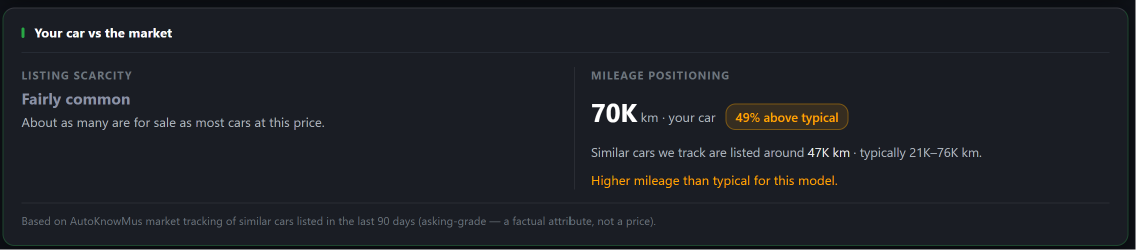
Inside the range, and still well above the middle. One car's screen — yours will look different.
Look closely at this one. The car's reading sits inside the range. Yet the panel says it is well above typical. Both are true.
The range shows where the middle half of similar cars sit. The badge compares your car with one number: the middle. A car can sit comfortably inside the range and still have been driven a lot more than the car in the middle. A buyer who sees this car next to the others will notice the gap, even if it is "within the range."
The panel does not blend these into one happy message or one sad one. It shows each fact on its own, clearly, so you decide what they mean together. That is not the panel being cautious. That is the panel being honest.
Six questions to put to your panel
Ninety seconds. Your panel answers all six.
How much interest is there? The second half of your label: the interest buyers usually show in cars of your brand and age.
What is your car being compared with? Similar cars, measured against other cars at the same price. Not just your model. Everything the same money can buy.
Where are those cars? Across the whole country, not only your city.
When is this true? Recently. The panel is built from similar cars listed for sale in the last 90 days. Cars come and go every week, so the picture moves too. What you saw a few months ago is an old picture.
Why does the label say what it says? Because of two facts crossed together: how many are for sale, and how much buyer interest there usually is. Never just one of them.
How far has yours been driven, next to theirs? Below typical, in line with typical, or above.
If you can answer all six from memory, you now know something about your own car that most sellers never find out. And the buyer knew all six before you did.
Seven ways sellers misread where their car stands
In this trade, sellers rarely lose money because they don't know their car. They lose it because they misread the cars around it. Here are the seven ways it happens. Six of them are about how you look. Only one is about the world outside.
1. You
"My car is special." Of course it is. It carried you to work, to weddings, to the hospital at two in the morning. But the buyer was not in any of those journeys. To them, your car is one of several on a list. The memories are yours. They don't transfer with the papers.
2. The car itself
You judge your car by how it feels to drive. Smooth, quiet, reliable. But buyers compare on paper first: year, variant, kilometers, how many are for sale. They only feel the drive after your car has already made it onto their shortlist.
3. What you looked at
Three cars you noticed for sale in your area last month. That is not the market. That is three cars. A small handful can be very different from the full picture.
4. How you counted
You counted the flats and forgot the people asking. You saw few cars for sale and never asked who wanted one. Half the story, read as the whole.
5. How you measured
You checked your kilometers against your car's age, found them normal, and stopped there. That check is useful: it tells you whether your car was used normally. But it doesn't tell you where your car stands among the cars recently for sale. Do both checks. They answer different questions.
6. Nobody looked again
You checked once, months ago, and the picture stayed frozen in your head. Meanwhile cars came up for sale and cars sold. The market you remember is not the market the panel shows now.
7. Where you are
Your city may be busier or quieter than the national picture. What you see nearby can differ from the panel. Both are real. Know which one you are looking at.
Look at that list again. Only the last one is about the world. The other six are about the way we look at our own car.
⚠️ The expensive one is #4
Counting the flats and forgetting the people asking costs sellers more than the other six together. "Only a few for sale" feels like a reason to ask more. Without buyers looking, it is not. Always read both halves of your label.
Why the whole country, and why no rupees
The panel compares your car with similar cars that AutoKnowMus has tracked for sale across the whole country in the last 90 days, not only in your city.
The reason is simple. A few cars in one city can change a lot from one week to the next. A much bigger group gives a steadier, more honest picture.
Two honest points come with this.
Your city may be different. The cars near you may not match the national picture exactly. The panel shows the bigger picture. Your street is one part of it.
A car for sale is not a car sold. Some cars stay up for sale long after they have gone. And the price a seller asks is not the price a buyer pays. That is why this panel never puts a rupee figure on anything. It is built from cars for sale, and cars for sale can tell you about position — how rare, how wanted, how far driven — but they cannot honestly tell you a price. Your estimated range comes from your valuation, which is built a different way.
💬 Six things a seller who has seen the comparison has
Position — you know where your car stands among the others. Pool — you know what it is being compared with. People — you know how much buyer interest there usually is. Place — you know the difference between your city and the country. Proof — you can point to the panel instead of saying "trust me." Peace — nothing the buyer tells you about the other cars is news to you.
A seller who has never looked at the comparison has none of the six.
What this panel will never do
It will never tell you to sell today.
It will never tell you to wait.
It will never tell you what to ask.
It does one thing, and does it plainly. It shows you the market your car is standing in, so that when you sit down with a buyer, you both know the same things.
For most of the history of used cars, the buyer came to the table knowing more than the seller. They had looked at more cars. They had seen more prices. They knew the comparison and you did not.
That gap is the whole reason this panel exists. Close it, and the conversation changes. You are no longer defending your car against a comparison you can't see. You are looking at the same comparison, side by side.
The decision is yours. It always was. Now it is an informed one.
The short version
| The question | What the panel shows | What it means for you |
|---|---|---|
| How many are for sale? | Fewer, about as many, or more than other cars at the same price | How easy it is for a buyer to walk away and find another |
| How much interest? | The buyer-interest half of your label, estimated from brand and age | Whether being rare actually helps you |
| "Rarely sold"? | Few for sale, and buyer interest usually low | Rare without demand does not lift the price |
| How far driven? | Your reading against the middle of similar cars | Below, in line with (within 5%), or above typical |
| Compared with whom? | Similar cars across the country | The big picture; your city may differ |
| What price? | None, on purpose | Cars for sale show position, not price |
One line holds it all together: your car is never judged alone, so never judge it alone.
🎯 Why this matters to us at AutoKnowMus
Think about who usually knows how your car compares. The dealer does; they see cars like yours every month. The buyer does; they spent evenings scrolling through every similar car for sale. Very often, the only person at the table who has never seen the comparison is the owner.
We built AutoKnowMus to change that. We don't buy cars. We don't sell them. We don't list them. Not one rupee of ours moves depending on where your deal lands, so we have no reason to make your car look rarer, or more common, than it really is. The same facts are shown to Sellers and Buyers alike. Here is how we work out a price. The verdict is never for sale.
See the comparison before the buyer shows it to you.
FAQs
How do I know how my car compares to other cars for sale?
Look at two things: how many similar cars are for sale, and how much buyer interest there usually is for that brand and age. Then check how your kilometers compare with the middle of those cars. The "Your car vs the market" panel on your AutoKnowMus Seller dashboard shows all of it on one card.
What does "Hard to find" mean on my Seller dashboard?
It means fewer cars like yours are for sale than most cars at the same price, and buyer interest is usually high for your car's brand and age. That is what separates it from "Rarely sold," where interest is usually low.
Does a rare car always sell for more?
No. Being rare helps only when people are looking for that car. "Rarely sold" means few are for sale and buyer interest is usually low for that brand and age, so the rarity does not lift the price.
Is buyer interest measured from live searches?
No. AutoKnowMus estimates it from how sought-after the brand is and how old the car is. That is why the panel says "usually … for this brand and age." The other half of the label, how many are for sale, comes from similar cars listed in the last 90 days.
Is "Fairly common" or "Lots for sale" bad for my car?
No. It means buyers know your kind of car well and have plenty to compare it with. It makes how your car compares, especially on kilometers, more important, not less.
What does "in line with typical" mean for kilometers?
Your reading is within 5% of the middle reading for similar cars for sale. Outside that band, the panel shows whether your car has been driven less or more than typical.
How is this different from checking my kilometers against my car's age?
Checking against age (#04) tells you whether your car was used normally for how old it is. That helps you explain your car. This panel tells you how your kilometers compare with the other cars for sale. That shows you how your car looks when a buyer is comparing. The two answers can be different, and both are useful, each for its own job.
Why does the panel compare across the country and not just my city?
A bigger group of cars gives a steadier picture than a few local ones. Your city can still be different, so read the panel as the big picture and your area as one part of it.
Why doesn't the panel show any prices?
Because it is built from cars for sale, and an asking price is not a selling price. So it shows where your car stands, not a rupee figure. Your estimated range comes from your valuation.
I am buying, not selling. Does this help me?
Yes. The same labels tell you how much choice you have and how much interest cars of that brand and age usually attract. The kilometers view shows how one car compares with the others you are considering.
Does AutoKnowMus buy or sell cars?
No. We don't buy, we don't sell, we don't list, and we take nothing from any deal. We show one neutral picture, the same for both sides, so everyone at the table is looking at the same facts.
Write down the word your panel gives your car. Then write down what you believed about your car before you read this. Open your Seller dashboard, put the two side by side, and notice where they disagree. That gap is what the buyer already knew.
Next — #07 of 12. You have now done six of the twelve. Find out the six more things to do before you sell your car, starting with the next one.