Ask a seller what their car is worth and the figure comes out in one breath. Ask how many people are shopping for a car like theirs right now, and you get a blank look. That blank look costs money. The same price that works beautifully when buyers are lining up does almost nothing when they are not. So before you name a figure, check the line.
What this post covers
What the Market Demand card on your dashboard tells you, and the one thing it does not. The mistake that fools almost every seller. Seven things that make the line of buyers longer or shorter. Six questions, and six fixes. If you have not read them yet, what affects your price and picking your speed on the price slider sit just before this one.
Three yards, one story
A while ago I walked into three used-car yards pretending to be a buyer.
My list was simple. The small hatchback you see at every traffic signal. The compact SUV every family asks about. The mid-size SUV everybody wants to be seen in. Nothing unusual. The most asked-for cars in the country.
The first dealer laughed. "That one does not stay here even two days."
Then the dealer walked me to the back of the yard, past the office, to a car I had not asked about. Dust on the bonnet. Tyres a little soft. It had clearly been parked in that spot for a long time.
"Take this one. Very good condition. I will make it work for you."
The second yard. Same thing.
The third yard. Same thing again.
Three yards. Three dealers. One story. The cars people wanted were never there. The car that was there, nobody wanted.
Here is what stayed with me. Both kinds of car were decent. Both had been owned by ordinary, careful people. The difference was not the engine, or the paint, or the seats.
The difference was the line of people who wanted it.
The dealer knew exactly which car had a line and which did not. The dealer always knows. That knowledge is half of how a yard makes money.
Most private sellers do not know. And so they set their price blind.
Think of a mango cart
Picture a mango seller on a street corner in May.
There is a line. People are waiting, holding bags, checking their phones. The seller does not bargain much. Nobody needs to. The cart is empty before lunch.
Now picture the same seller, same cart, same corner, in November. Same price. Same fruit, looking just as good.
The cart goes home full.
Nothing about the mangoes changed. The line changed.
Your car works exactly the same way. Every price you name is a message to a crowd. When the crowd is big, somebody answers quickly. When the crowd is thin, the very same price just sits there, and you start to wonder what is wrong with your car.
Usually nothing is wrong with your car. You were talking to an empty street.
In the price slider post you saw that your price decides who can afford you. This post is about the question underneath it:
How many people were there to begin with?
What the Market Demand card tells you
On your seller dashboard, in the Market Indicators section, sits a small card called Market Demand. It shows one word.
HIGH. Strong buyer interest. More buyers competing at a fair price.
MEDIUM. Moderate interest. Steady enquiries at a fair price.
LOW. Limited buyer interest. Fewer buyers in the market for a car like this.
Tap the small i beside it and it spells out what each level means.
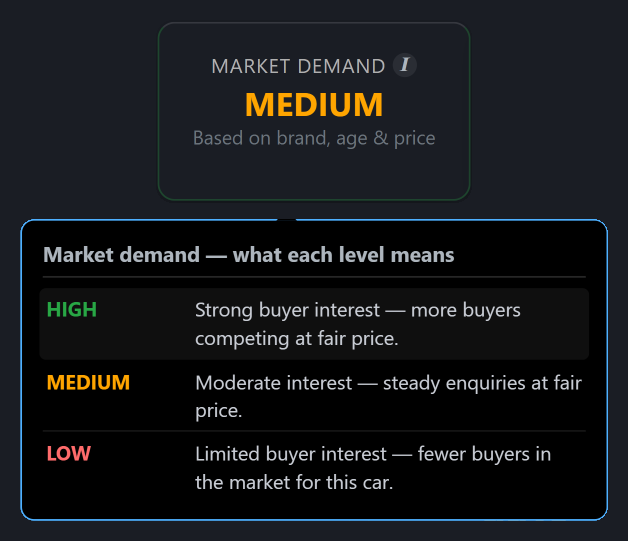
One word, three possible answers. This car shows MEDIUM — yours may show a different level.
Now the honest part. Read the small line under the word. It says: based on brand, age and price.
That card is not counting the people who phoned you. It cannot. Nobody can. What it does is read the kind of car you have, and tell you how buyers usually treat that kind of car.
Think of it as a weather report, not a headcount. It will not tell you who knocks on your door on Tuesday. It will tell you whether to expect a crowd or a quiet street, and it tells you before the ad goes up — before you lose three weeks finding out the hard way.
Same car shape, three very different lines. An illustration, not a count — the card shows a level, never a number of people.
The line decides the wait
Right next to the demand card sits Days to Sell. In the price slider post you moved the slider and watched that number change. Demand is the reason your days are different from your neighbour's. Same slider position, different line of people, different wait. The price decides how many people can buy. Demand decides how many want to.
The mistake that fools almost everyone
A seller opens a website. Types in their car. Two hundred cars just like it come up for sale.
And the seller breathes out. "Lots of these around. Must be a popular car."
Stop. Look at that screen again.
Two hundred cars for sale is two hundred sellers. It does not tell you about a single buyer.
Think about a railway platform. You walk in and it is packed from end to end. Do you think, "trains must be coming often today"?
No. You think the opposite. A crowd of people waiting means the thing they are waiting for is not arriving fast enough.
A screen full of cars like yours can mean exactly the same thing. Lots of sellers. Not enough buyers to clear them.
And one more thing. A car that still shows up on a website has not proved it is unsold, and it has not proved it sold either. An ad tells you somebody hoped. It never tells you somebody paid. We wrote a whole post on the gap between asking and selling.
Four things that look like demand, and are not
- Lots of cars like yours for sale. That is a count of sellers, not buyers.
- A dealer calling within the hour. Dealers call about almost every car. Finding cars they can buy for less is their job, not a sign of a crowd.
- Lots of views on your ad. A view is a thumb that paused. It is not a person with money and a reason.
- Seeing your car everywhere on the road. Plenty of people owning a car is not the same as plenty of people shopping for one this month.
Seven things that make the line longer or shorter
Anyone who has worked in a factory knows this list. When something goes wrong on the line, you check seven things: the people, the machine, the material, the method, the measurement, the management, and the environment around it all.
The line of buyers for your car is built by the same seven.
1. The people — who is shopping
First-time buyers. Growing families. Someone moving up from a two-wheeler. Someone who needs a second car for the school run.
The more kinds of people your car suits, the longer the line. A car that fits one kind of life has one kind of buyer. A car that fits five has five.
2. The machine — what kind of car it is
Tastes move. What families asked for ten years ago is not what they ask for now. Body styles come into fashion and quietly go out.
Fuel matters more than ever too. Buyers ask what the car costs to run, and whether it will still be easy to live with a few years from now. Their answer to that question moves the line before they ever see your car.
3. The material — what the car carries with it
The service record. Clean papers. How many owners. Whether the small things work.
This is the station the demand card cannot see, and the one you control completely. A car with its history in a folder draws a longer line than the same car with a shrug.
4. The method — how buyers pay
Many buyers need a loan. Lenders have their own rules — how old a car they will fund, and how much.
When your car slips past one of those rules, a whole group of buyers drops out of your line. Not because they dislike the car. Because the bank said no. You never see these people leave. They simply never arrive.
5. The measurement — the boxes buyers tick
Almost nobody browses every car. Buyers search with boxes: year from, kilometers under, price under.
Your car either lands inside those boxes, or it is invisible.
Read that again, because this is the one that hurts. One year older, or a few thousand kilometers past a round number, and your car can vanish from searches you never knew were happening. Same car. Half the audience. Overnight.
6. The management — the brand behind the car
How many service centres are nearby. How easy parts are to find. Whether the maker still sells that model at all.
When a maker stops selling a model, buyers start asking a nervous question: will I still get parts in five years? That one question, asked quietly in a hundred heads, shortens the line.
7. The environment — the season and the city
Festivals. Year-end. A new model landing that makes last year's look old. A change in fuel prices. And your city, because a car with a long line in one city can sit for weeks in another.
This one is outside your control. It is not outside your knowledge.
Walk the line one more time
The demand card reads brand, age and price. Those three touch the machine, the method, the measurement and the management all at once, which is why one word can say so much.
What the card cannot read is the material: your papers, your condition, your service book. That part of the line is yours to build.
The three things you are really trading
In post #02 we said every sale has three things inside it, and you only get to pick two. Factory people call it quality, cost and delivery. For a car, that is how good the car is, the price you get, and how soon it is gone.
Here is what nobody adds.
Demand decides how much room you have to play with.
When the line is long, a well-kept car, a fair price and a quick sale can all happen together. Buyers are competing for you.
When the line is short, you usually give on one of them. Either the car has to be better than the others, or the price has to reach more people, or the wait gets longer.
Nothing is wrong with a short line. What is wrong is not knowing you have one, and expecting all three anyway.
What to do with each answer
Seller first, always.
If your card says HIGH
The biggest danger here is fear.
Sellers with a strong line often grab the first offer, because they are nervous nobody else will come. Somebody else will come. That is what HIGH means.
Let a few buyers look. Let them compare you against each other instead of against other cars. And stay inside your fair value range — a strong line helps you reach a fair price with less haggling. It does not change what the car is worth.
If your card says MEDIUM
Here, the car does the talking.
Buyers have choices, so they compare. Clean car. Complete papers. Clear photos. Straight answers. The seller who makes the choice easy is the seller who gets picked.
If your card says LOW
A thin line does not get longer just because you wait. Tomorrow's buyers will not want this car more than today's.
So waiting is a choice with a cost, not a plan. Count what that waiting costs you before you choose it.
Then work on the things that reach more of the people who are out there: where your price sits, where you show the car, and who you are speaking to.
And please hear this: LOW does not mean your car is bad. It means fewer people are shopping for that kind of car right now. Those are completely different problems, and only one of them is about you.
Finish this sentence before you sell
"My car shows ______ demand, so my plan is ______."
If you cannot fill in the second blank, you are about to set a price without a plan behind it.
Six questions about your buyers
Two minutes. Answer them before you look at a single price.
Who is shopping for a car like yours? Picture the actual person. A young couple? A family of five? If you cannot picture them, your ad cannot talk to them.
What are they really looking for? Low running cost? Space? A name they trust? Does your car answer that — out loud, in the first line of your ad?
When do they shop? Around festivals, bonuses, the new school year? Know whether your buyers are out in force this month or next.
Where are they looking? Your buyers are somewhere specific. Where you sell decides whether you meet them at all.
Why would they pick yours over the other cars on the same screen? Give one reason. One. If you do not have one, they will not find one.
How will they pay? If most people buying a car like yours use a loan, check whether yours still fits what lenders fund.
Most sellers skip all six and go straight to the price. The price then has to do all the work alone.
Six things to fix once you know your line
The six Ps
Position — where your price sits against where buyers are actually shopping. Presentation — clean, the small repairs done, honest photos. Papers — registration, insurance and service record ready before the first call. Place — the car shown where your buyers look, not where it is easiest for you. Pitch — the one sentence that says why this car. Patience — matched to your line, not to your mood.
A seller with a long line needs only a few of these. A seller with a short line needs all six.
The short version
| Your card shows | What it tells you | What it does not tell you | What to do |
|---|---|---|---|
| HIGH | More buyers competing at a fair price | That the car sells at any price | Let buyers compare, stay inside fair value |
| MEDIUM | Steady enquiries at a fair price | Which car they will pick | Make yours the easy choice |
| LOW | Fewer buyers in the market for this kind of car | That your car is bad | Reach more buyers, and count what waiting costs |
One line holds it together: your price speaks, but demand decides how many people are there to hear it.
Why this matters to us at AutoKnowMus
Everyone who talks to you about demand has a reason to shade it. A dealer who wants your car tells you nobody is buying. A buyer tells you there are plenty of others just like yours. A friend tells you your car is very popular, because friends are kind.
We have no reason to shade anything. We do not buy cars. We do not sell them. We do not list them. Not one rupee of ours moves whether your line is long or short — which is why we can give you the reading straight, next to a fair value that is the same figure for the seller and the buyer. Here is how we work it out. The verdict is never for sale.
Count the line first. Then name your price.
FAQs
How do I know if there is demand for my used car?
Start from the kind of car you have — its brand, its age and its price — because those shape how buyers usually treat it. The Market Demand card on your AutoKnowMus seller dashboard reads exactly those and shows HIGH, MEDIUM or LOW before you put up a single ad. Then check what the card cannot see: your papers, your condition, and whether you are showing the car where your buyers actually look.
There are lots of cars like mine for sale. Does that mean demand is high?
No. A screen full of cars like yours is a count of sellers, not buyers. It can even mean the opposite — plenty of people trying to sell, and not enough people buying to clear them. An ad only shows what someone hoped for. It never shows that anyone paid.
My car shows LOW demand. Does that mean it is a bad car?
No. LOW means fewer people are shopping for that kind of car right now. It says nothing about how well yours has been looked after. A well-kept car with a short line of buyers still sells — the seller just needs to plan for fewer people, reach them in the right places, and know what waiting costs.
If my car shows HIGH demand, can I ask for more than the fair value?
A strong line helps you reach a fair price faster and with less haggling. It does not change what the car is worth. Pricing above the fair value range shrinks the very line you just found out you had, because fewer people can afford you.
Why does the card not show how many buyers there are?
Because nobody can honestly count them. A precise number of buyers would look like a fact and be a guess. A level based on brand, age and price is what can be said truthfully, so that is what the card shows.
Can the demand for my car change?
Yes. The season changes it. New models landing change it. Fuel prices change it. And your own car changes it, the day it becomes a year older or crosses a round number of kilometers that buyers use as a search filter. Check the card again when you are ready to set your price, and again if things go quiet.
Why do dealers call me so quickly after I post an ad?
Because finding cars they can buy for less and sell for more is their job. A fast dealer call is not proof of a crowd of buyers. Judge demand by the kind of car you have, not by how quickly the first call arrives.
How is Market Demand different from Expected Days to Sell?
Demand is the size of the line. Days to sell is the wait that line usually produces at a given price. Move your price and the days change. The line itself stays the same, because it depends on the kind of car you have.
Does AutoKnowMus tell me when to sell?
No, and that is on purpose. We show you how buyers usually treat a car like yours and what its fair value is. When to sell is your call. We do not buy, sell or list cars, and we take nothing from any deal, so we have no reason to hurry you or to hold you back.
Before you write down a price, write down one word: HIGH, MEDIUM or LOW. Check which one your car shows, then build your price around the line you actually have.
Next — #06: How sure is this price? Every figure on your screen comes with a confidence level. Here is how to read it before you trust it.