Every other cost of owning a car arrives with a piece of paper. The insurance renewal. The service bill. The fine. The cost of waiting to sell arrives with nothing at all — no message, no bill, no warning — and by the time you notice it, you have already paid it. A car standing still, untouched, unused, loses value in steps you can name in advance: the year turning over, the odometer crossing a round figure, the insurance and service dates creeping closer, a newer model arriving, and your own advertisement going stale. And a sixth one nobody warns you about — the clock wears down the seller faster than it wears down the car. Before you set your price, find out what a month of waiting costs. Then every offer stops being a feeling and becomes a comparison.
What this post covers
Why time — not condition, not cleaning, not accessories — is the thing quietly moving your car's price while it sits unsold. Six causes in plain language, how to read your own 90-day graph, and the one amount to write on a piece of paper before you talk to a single buyer. New here? Start with why an asking price is not a selling price. Not sure you are ready at all? Run the 60-second check first.
You decide to sell in March.
You have a price in your head. It came from a neighbour, or a half-remembered line at a service centre, or a website you scrolled through once at midnight. It feels right.
April brings an offer, a little under your price. You turn it down. Politely. Confidently.
May brings a lower one. June brings phone calls at nine at night from people who never turn up. July brings a Sunday spent washing the car for someone who looks at it for four minutes and walks away.
In August you accept a price well below the April offer. And walking back inside, you feel like you fought hard to get it.
Here is the part that should stop you cold. You did not lose that money in the final conversation. You lost it in the five quiet months in between, when nothing seemed to be happening at all — and nobody, at any point, sent you a bill for it.
Nobody sends you a bill
Walk through any vegetable market at eight in the morning. The tomatoes are fresh. The price is firm. The vendor barely looks up when you try to bargain.
Walk through the same market at eight at night. Same vendor. Same tomatoes. Now the vendor is calling out to everyone who walks past, and will take almost any price you offer.
Nothing happened to the tomatoes. Everything happened to the clock — and to the person standing behind them.
That is your car sale. Not because your car is a vegetable, but because the same two things are happening at once: something is quietly losing value, and the person selling it is quietly losing patience. Most sellers watch only the first one. The buyer, standing in front of you, is watching both.
You see the ice. The buyer sees the water.
Put a big block of ice on the table on a hot day.
You look at it and think: it is still a big block. It will still be here tomorrow.
And you are right. It will be there.
But the buyer is not looking at the ice. The buyer is looking at the water spreading across the table.
That water is your money. It has already left the block. You just have not counted it yet.
This is the whole gap in a used-car deal. Not the price. What the two of you are looking at.
So let us look at the water.
Six things that move your price while the car just sits
None of this is about how you drive, or how well you clean the car, or what you spent on it. This happens to a car parked in the same spot, untouched, all month.
1. The birthday nobody celebrates
On the last night of December, your car is a 2020 car. You wake up the next morning and it is exactly the same car — same engine, same paint, same everything, one night older.
But now buyers say it differently. It is "a year older." A whole step down, for one night's sleep.
Every car has one date in the year where it drops a step in a buyer's mind. Sit past that date still holding it, and you paid for a birthday nobody attended.
2. The round figure on the dashboard
The odometer is the small counter on your dashboard that adds up every kilometre the car has ever travelled. Buyers do not read the exact reading on it. They read the nearest round figure.
A car showing 48,000 km is "under fifty." A car showing 52,000 km is "over fifty." Mechanically these are the same car — nothing wears out at exactly 50,000. In a deal, they are two different prices.
So be clear about what you are doing when you keep using the car during the months you are trying to sell it: you are spending the car. Every school run and weekend trip is a small withdrawal, and there is no way to put it back.
Check where you are standing before you plan any trip
Look at your odometer right now. How far are you from the next round figure — 40, 50, 60, 80, one lakh? If it is a few thousand kilometres away, that is a line you are walking towards at the speed of your daily commute. Knowing this is not worrying. It is the same as knowing how much petrol is in the tank.
3. The dates walking towards you
Two pieces of paper decide a lot here, and both have a date on them.
Insurance. A car with eight months of cover left is a car the buyer can get into and drive away. A car with three weeks left is homework — the buyer has to arrange it, spend money, wait for paperwork. That homework gets priced in, and not kindly.
The service record. A car freshly serviced feels finished. A car with a service falling due next month feels like a bill the new owner inherits on day one.
Every week you wait, you move slowly from the first kind of car to the second. Nothing broke. The calendar just moved.
4. The newer model arrives
The maker launches an updated version, or the next generation entirely.
Nothing at all has happened to your car. Everything has happened to the word "old."
This one is completely outside your control, which is exactly why it belongs on a list you check before you start, not after. If your model is due an update, that is worth knowing on day one, not in month four.
5. Your advertisement gets old faster than your car
This is the one almost nobody warns first-time sellers about, and it is expensive.
Serious buyers do not decide in an afternoon. They watch. They see the same cars listed week after week while they make up their minds. So when your advertisement is still sitting there in week four, they do not think good car, still available, lucky me.
They think: why has this not sold?
And then they open low — not because your car is worth less, but because your waiting is now visible. That is the hard part. The oldest advertisement in any market attracts the worst offer in that market, every single time. Your patience is on display, and the person in front of you is reading it.
A stale advertisement is a discount you never agreed to
Nobody tells you this, because nobody is on your side of the table when it happens. The buyer is not being unfair — they are reading the only evidence they have. The fix is not to hide it. The fix is to know what waiting costs you, so you can choose to hold or choose to move on purpose, instead of drifting.
6. The clock does not just wear down the car. It wears down you.
Here is the one that costs the most, and it has nothing to do with the car at all.
Ask any seller in week one for the lowest price they will accept. Write it down. Ask the same question in month three.
It will have dropped. Not because the market said anything. Not because anything changed under the bonnet. Because they are tired — tired of strangers, tired of evening phone calls, tired of washing a car for people who never show up.
The market never wore them down. The waiting did.
That is why, in August, you accept less than you were offered in April and still feel like you fought for it. The price in your head had quietly dropped while you were not watching. Nobody dropped it for you. You did it yourself, one disappointing Sunday at a time.
How to read your graph — and what 30, 60 and 90 days really mean
This is why the very first thing on your AutoKnowMus seller dashboard, right beside your price, is a picture of time.
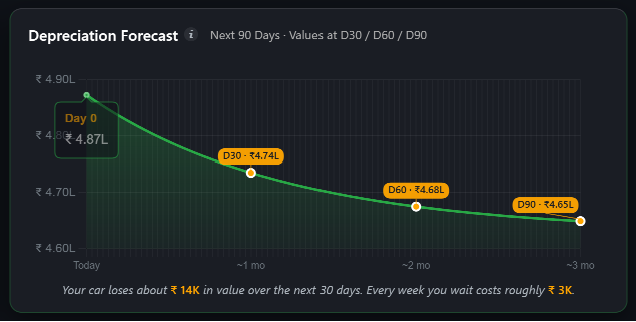
The Depreciation Forecast on the seller dashboard. Three dates, one falling line, and one sentence in plain words underneath.
You do not need to understand graphs to read this. There are only three things on it.
Why 30, 60 and 90 days? Not because those days are special. Because that is how people actually think about selling: this month, next month, or after that. So instead of guessing what "a couple of months" might cost you, the graph puts all three in front of you at once.
What each dot is telling you. Each dot is a price — what this car is likely to be worth if you are still holding it on that day. In the example above:
| If you sell… | Your likely price | What that month cost you |
|---|---|---|
| Today | ₹4.87L | — |
| In 1 month (D30) | ₹4.74L | about ₹13,000 |
| In 2 months (D60) | ₹4.68L | about ₹6,000 more |
| In 3 months (D90) | ₹4.65L | about ₹3,000 more |
Now look at that last column again, slowly. Because it says something almost nobody expects.
The first month costs more than the next two months put together.
That is what the shape of the line means. It falls steeply at the start and then flattens out. Waiting is not equally expensive every month. The most expensive month you will ever wait is the one you are in right now.
And here is the cruel timing of it. Month one is when sellers are at their most hopeful — turning down early offers, certain the right buyer is coming, in no hurry at all. So you spend your most expensive month feeling the most confident. By month three, when you have finally softened and would take a fair offer gladly, waiting has become cheap. But the expensive part is already paid for, and there is no getting it back.
The line underneath the graph. This is the one that matters most, and it is written in ordinary words: loses about ₹14K over the next 30 days. Every week you wait costs roughly ₹3K.
Three thousand rupees a week. Sit with that for a second. If ₹3,000 left your bank account every Monday morning, you would notice by the second week and do something about it by the third. It happens anyway. The only difference is that nobody takes it out of your account, so nobody tells you.
These are one car's figures, not a rule
₹4.87L, ₹14K, ₹3K a week — that is one specific car, in one specific month. Yours will be different, and that is exactly the point. An older car's line is much flatter. A newer one falls harder. Anybody who hands you a single percentage that supposedly applies to every car is guessing. Read your own graph, for your own car.
Write this amount on a piece of paper
Find your 30-day figure. Write it down. On actual paper — the back of an envelope is fine. Put it in your wallet, or stick it on the fridge, somewhere you will see it when a buyer calls.
Here is what it does to a negotiation.
Right now, when an offer comes in below your asking price, you ask yourself a useless question: is this less than I wanted?
It always is. Every offer always is. That question has never once helped anybody.
With the waiting cost written down, you finally get to ask a better one.
The question to ask instead
Is this offer below my price by more than another month of waiting would cost me?
If the answer is no — you are not accepting a low offer. You are refusing an expensive delay.
Those are two completely different decisions. One of them keeps you awake wondering if you gave in too easily. The other is arithmetic you did in advance, on paper, when nobody was standing in front of you.
The one question underneath all six
"If I still have this car in thirty days, what will that have cost me — and did I choose it, or did it just happen?"
Waiting is a perfectly good decision. Plenty of sellers should wait, for perfectly good reasons. The only bad version is the one nobody actually decided on.
The short version
| What moves | What actually happens | Can you control it? |
|---|---|---|
| The year turning over | Same car, one step older in the buyer's mind | No — but you can know the date |
| Odometer round figures | "Under fifty" and "over fifty" are two prices | Yes — stop spending the car |
| Insurance & service dates | A ready car becomes homework for the buyer | Yes — time it, or refresh it |
| A newer model arrives | Nothing changed except the word "old" | No — check before you start |
| Your advertisement going stale | Visible patience gets priced against you | Yes — decide, do not drift |
| Your own patience running out | Your lowest price quietly falls | Yes — write it down on day one |
Five of these six happen to the car. The sixth happens to you — and in this business, that is usually the expensive one.
Why this matters to us at AutoKnowMus
There is no "sell now" button on AutoKnowMus. There is not going to be one.
Anyone who tells you the market is about to turn, or that prices will firm up after the season, or that you really ought to hold on another month — that person is guessing. And in this business, the people guessing out loud usually have a reason to want you guessing along with them.
We do not buy cars. We do not sell them. We do not list them. Not one rupee of ours moves depending on where your deal lands — which is exactly why we can hand you the price straight, the same figure whether you are the seller or the buyer. The full method is here. The verdict is never for sale.
So we will not tell you when to sell. What we will do is the arithmetic on your car, and put it where you can see it: here is the shape of your line, here is what thirty days costs at your price. What you do next is genuinely your business — because you are the only one who knows whether you need the money this month, or would rather hold out for the right buyer.
"Sell now" is advice, and advice always has a side. "This is what waiting costs" is a fact, and you are free to argue with a fact.
Choose to wait, or choose to move. Just do not let the calendar choose for you.
FAQs
How much value does a used car lose in a month?
Why does the graph show 30, 60 and 90 days?
Is it worth selling before the year changes?
Does driving the car while I am selling it reduce the price?
My car has been listed for two months with no offers. What is happening?
Should I wait for a better market?
Does AutoKnowMus buy or sell cars?
Nothing about your car changed this month. The calendar changed. Find your price, find your 30-day figure, and write it on something you will actually see — so the next offer that comes in is a comparison instead of a feeling.
Next — #02: Sell to a date, not to a price. Most sellers do not really want a price. They want the car gone before a particular day — a move, a delivery, a deadline. There is a way to start from the date and work backwards, and almost nobody does it.