Let me guess how this started.
Somebody sold the same car as yours. Same model. Same year. Possibly the same colour. And they got more money than the number you have just been given.
You heard about it in the lift. Or at a wedding. Or from a cousin who "knows about cars."
And ever since, a small voice in your head has been saying the same thing on a loop.
I am being cheated.
📍 What this post covers
The five things that actually move your car's price. Which one is hurting you, which two are helping you, and which two you have been losing sleep over for absolutely no reason. If you have not read them yet, where the price in your head came from comes just before this one, and what waiting costs you and selling to a date instead of a price sit underneath that.
First, the tailor
Two men walk into the same tailor shop. Same day. Same design. Same cloth.
One walks out paying more than the other.
Was he cheated? No. He has broader shoulders, so the jacket took more cloth. He also asked for the good lining. And he wanted it by Friday.
Three reasons. All visible. All measurable. Nobody argued, nobody sulked, nobody went home feeling robbed.
Now think about how a used car gets priced.
Somebody looks at your car, does something in their head, and says a number. That is it. No reasons. No breakdown. Just a number, delivered with a straight face.
Of course you want to fight it. I would too. Anybody would.
A number with reasons is a completely different thing from a number without them. One you can check. One you can only swallow.
That is the whole point of what I am about to show you.
What a mechanic sees that you do not
I have spent over twenty years around used cars. Here is something that happens to you after a while: you stop seeing "a car." You start seeing six separate things.
The hands. How many people have owned it.
The machine. What is worn, what is tight, what makes a noise it should not.
The material. What has been replaced along the way, and what has been quietly ignored.
The method. How it was driven. Highway cruising, or ten years of stop-start traffic.
The measurement. What the meters actually say. Years and kilometres.
The mahaul. Where it lived, and whether what is in its tank is what people want right now.
Six things. Not one feeling.
Your dashboard measures five of them straight away. And the sixth one — it does something unusual. It tells you openly that it is missing. Remember that. We will come back to it, and it is the best news in this entire article.
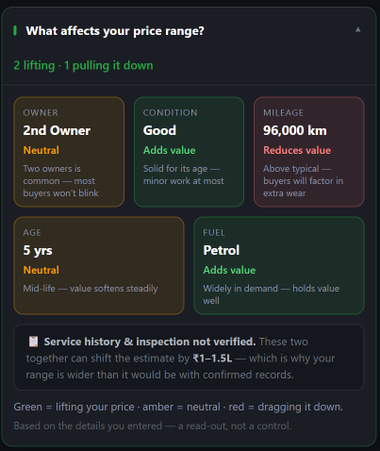
Green means it is lifting your price. Amber means it is doing nothing much. Red means it is pulling you down. This is one car's screen — yours will look different.
The scary number that is not scary
Look at the red tile. Ninety-six thousand kilometres.
Read that again. Did something in your stomach move? It does that to almost everybody. Six figures on the odometer feels like a death sentence. Sellers start apologising for it before the buyer has even opened his mouth.
Now let me destroy that fear with one question.
Ninety-six thousand kilometres over how many years?
Because that changes everything. Watch.
Ninety-six thousand on a fifteen-year-old car? That car has barely been used. It has been sitting in a garage being loved.
The exact same ninety-six thousand on a two-year-old car? That car has been driven like a taxi. Hard, daily, no rest.
Same number. Completely opposite stories.
So here is the truth nobody has ever bothered to tell you:
The odometer, by itself, tells you nothing. It is half a sentence. It is like someone saying "I spent forty thousand rupees" and stopping. Forty thousand on what? Over how long? You cannot judge anything yet.
The real question is always: how far, per year?
This car is five years old. Divide it out and yes — it has been driven noticeably more than a normal car its age. That is why the tile is red.
But look closely at what the tile is saying. It is not saying your car is finished. It is not saying you should be ashamed. It is saying: a buyer will expect more wear, and he will bring it up.
That is it. That is the whole crime.
And now you know it is coming. You can walk into that conversation standing straight instead of getting ambushed.
💡 Do this right now. It takes four seconds.
Take your kilometres. Divide by the age of your car in years.
Around ten thousand a year or less — your car has had an easy life. Say it proudly.
Somewhere in the teens — completely normal. Most cars live here. Nobody will blink.
Well above that — expect the buyer to talk about wear. Not a disaster. Just be ready.
I promise you have never done this sum about your own car. Almost nobody has.
The two things you are worrying about for nothing
Now the amber tiles. This is where sellers waste most of their worry and get nothing back for it.
"But I am the second owner."
Ah. This one. Every seller says it in the same guilty voice, like they are confessing something at a police station.
Relax. Two owners is completely normal. Look around any parking lot — most cars that age have had two owners. The buyer sees it, thinks nothing, and moves on to the next thing.
"But the car is five years old."
Yes. And?
Sellers hear "five years" and imagine a cliff. Like the car crossed some line and everything collapsed. There is no cliff. The value comes down like a slope — slowly, steadily, the same way it has been doing quietly since day one. Nothing dramatic happens because a car had a birthday.
Now, why does this matter so much?
Because a seller who is scared of something will flinch when the buyer mentions it. And every buyer in the world can smell a flinch from across the room. The moment he sees it, he stops negotiating with your car and starts negotiating with your fear.
These two amber tiles are handing you a gift. They are saying: stop being scared of this. It is not costing you anything.
The two things helping you that you never mention
Look at the green tiles now.
The condition is good. Less for the buyer to fix, less for him to argue about.
And it runs on petrol. Huge crowd of buyers. No confusion, no city rules to worry about, no awkward questions about what happens in three years.
Both of these are lifting your price. Right now. Today.
And here is what gets me every single time.
Ask any owner to describe his car honestly and you get a confession list. The scratch on the bumper. The rattle in the door. That week it spent at the workshop. The tyre that is probably due. All true, all volunteered, all for free.
Not once — not once in twenty years — has an owner opened with "the condition is genuinely good and it runs on the fuel everybody wants."
We are trained to list our faults and completely ignore our strengths. It is very decent behaviour. It is also, across a negotiating table, very expensive.
You cannot argue for something you have not even noticed.
What is actually going on in the buyer's head
Strip everything away and the man in front of you is weighing exactly three things.
How good is it? How much car am I getting, and how much of it becomes my headache?
What does it cost? What leaves my pocket today?
How easy is it? Can we finish this cleanly? Papers ready? Loan closed? Both keys? Will this man pick up his phone tomorrow?
Now here is the part almost nobody uses.
Those three trade against each other. Constantly.
A car with a few extra kilometres but a folder where everything is in perfect order will beat a nicer car whose owner cannot find the second key and needs three days to "check something with the bank."
Read that again, because it is worth money.
Most sellers spend every ounce of energy fighting about the one thing they cannot change — and zero effort on the two things they could sort out this weekend.
Six questions. Ninety seconds. Ask your car.
Who has owned it, and how many? The real count, not the feeling.
What condition is it in? Not what you feel about it. What a stranger walking around it slowly would write down.
When was it made, and where is it in its life? Mid-life is not a crisis. Do not sell it like one.
Where are you selling it? Demand is a local thing. Always has been.
Why is a tile red? There is a sentence next to it explaining exactly why. Read the sentence.
How far per year? Not how far in total. This is the one everybody gets wrong, and it is the one that moves the most money.
Most people fail on what and how. They describe their car far more kindly than a stranger would, and they read the odometer as a total instead of a rate.
⚠️ Even a fair price gets beaten if you cannot explain it
Say the number you have been given is completely correct. Perfectly fair.
If you cannot say why it is that number, you will still defend it badly. You will start explaining. Adding sentences nobody asked for. Talking a little too fast.
And the buyer hears it. Instantly. From that second onward he is not negotiating with your car. He is negotiating with your nervousness.
A correct price you cannot explain gets pushed down just as far as a wrong one.
Now the good news
Remember the sixth thing? The material. What has been serviced, what has been replaced, what has been skipped.
Under the five tiles there is a quiet line saying service history and inspection are not verified — and that confirming them would tighten your range.
That is not an insult to your car. It is an honest admission: there are things about this car we cannot see, and we are not going to pretend otherwise.
Now look at what that actually means for you.
Four of the five tiles are locked for ever. You cannot un-drive the kilometres. You cannot become the first owner. You cannot make the car younger. You definitely cannot change what is in the tank.
But your records? Those are sitting in a drawer.
That is the only thing on this entire screen you can still improve.
The folder in your cupboard. The workshop that has every job saved on their computer. One phone call, one afternoon.
And what do most sellers do in their final two weeks?
They polish the paint.
💬 Six P's that decide your number
Provenance — how many hands have held it. Preservation — what condition it is in today. Pace — how far per year, not how far in total. Period — how far into its life it has come. Popularity — whether people want that fuel right now. Paperwork — what you can actually prove.
Five of these are already decided and will never change.
The sixth one is in your drawer. Go and get it.
The short version
| The thing | What sellers fear | What is actually true |
|---|---|---|
| Owner | "Second owner ruins it." | Totally normal. Buyers barely notice |
| Condition | "They will find everything." | Good condition helps you — so say it out loud |
| Mileage | "That number looks terrible." | Only per-year matters. Do the division |
| Age | "Five years is a cliff." | It is a slope. Nothing snaps |
| Fuel | Never thought about it | Decides how big your crowd of buyers is |
| Paperwork | An afterthought | The only one you can still fix |
One line: everything you are worried about is already decided, and the one thing you could still fix is the one you have not touched.
🎯 Why this matters to us at AutoKnowMus
Almost everyone who gives you a number for your car is standing on one side of the deal. The platform buying it. The dealer taking it in exchange. The buyer across the table. Each one has a reason to say low. You have every reason to say high.
So every number comes with a stake attached. And that is exactly why nobody shows you the reasons — because a number with its reasons stripped off is much easier to push around.
We do not buy cars. We do not sell them. We do not list them. Not one rupee of ours changes depending on what your car sells for.
Which means we can show you the whole thing. Every factor. Which way it pushes. And the sentence saying why. Then we hand the exact same number to the person sitting opposite you. Here is how we work it out.
It is a read-out, not a control. Nobody can pay to turn a tile green. The verdict is never for sale.
Find out what is lifting your price. Then stop apologising for the rest.
FAQs
Does being the second owner reduce my car's value?
Is high mileage always bad?
How much does service history affect the price?
Does fuel type really matter?
When does a car lose the most value?
Open your own car's screen. Look only at the amber tiles — those are the things you were getting ready to apologise for. Then look at the green ones — those are the things you were never going to mention.
Next — #05. You have a number, and now you have the reasons behind it. The next screen answers a different question altogether — and it is the one most sellers never think to ask.