Ask someone what price they want for their car and the answer comes straight away. Ask them by when, and there is a pause. That pause is the whole problem. Almost every seller has a date — a move, a delivery, money that is needed by a certain day. The date is real and it is fixed. The price is the part that can move. Start from the day and work backwards, and you are steering the sale instead of hoping it works out.
What this post covers
The three things in every sale and why you cannot pick all of them. Six questions that tell you whether your date is real. Seven things that make people miss it. And what lights up on your dashboard when you start from the day instead of the price. If you have not read it yet, what waiting costs you is the post underneath this one.
Ask a seller what price they want. The answer comes in a second.
Ask by when. There is a pause.
Then it comes out. The move is in six weeks. The new car arrives next month. The money is needed before the fees are due.
There is almost always a date. Nobody asked about it.
So you name a price instead. Now you are holding two things — a price you said out loud, and a date you never mentioned.
One of them will have to move. It is never the date.
You already do this with flights
You never say: "I will travel when tickets cost four thousand rupees."
You say: "I need to be in Delhi on Friday." Then you look at what Friday costs.
Maybe Friday is expensive, so you shift to Saturday. Maybe it is fine, so you book it.
Either way you made a choice, because you could see what that day costs.
Selling a car works the same way. Almost nobody sells like this.
The three things you cannot all have
Every car sale has exactly three things inside it.
The price you get.
The day it is gone.
What the waiting costs you.
Here is the hard part, and almost nobody says it out loud.
You can decide any two of them. The third one gets decided for you.
Fix the price and fix the day, and you have no idea what the wait will cost — you just find out later, when the money is already gone.
Fix the price and accept the cost, and the day becomes whenever it happens. Could be March. Could be August.
Fix the day and know the cost, and the price is simply what you find out. That is the only version where nothing is hidden from you.
Most sellers fix the price and nothing else. Then they are surprised by both of the other two.
This is not unique to cars
Any factory manager will tell you the same thing about any job: you can have it good, you can have it cheap, you can have it fast — pick two.
Selling a car is a job like any other. The only difference is that nobody hands you the three choices, so you make one of them by accident.
What happens when you start with a price
You pick a price. You have no date.
An offer comes in below it. You say no.
And why not? Saying no costs you nothing today. Nothing is pushing you.
Another offer arrives, a little lower. No again.
Now look at what you have built. A price, with no end date attached to it.
That is not a plan. That is permission to wait forever.
And waiting is not free. Your car loses value every week it sits unsold, and nobody sends you a bill for it.
A price with no date is not a decision
It feels like one. You picked a figure. You are holding firm.
But a real decision costs you something if you get it wrong. This one does not. Nothing happens if you are still holding the car in four months, except that you have less money and less patience. And nobody points that out at the time.
What happens when you start with a date
Now say it the other way round. "The car has to be gone by the 15th of next month."
Three things change straight away.
You can see what that day costs. A sooner date usually needs a lower price. That is not bad news. It just means you can finally see what you are trading.
You stop drifting. An offer is no longer just high or low. It is either good enough for the time you have left, or it is not. That question has an answer.
You can change your mind honestly. If the 15th turns out to be expensive, you can decide the move waits two weeks. That is a real choice. Waiting because nothing stopped you is not.
Six questions about your date
Answer these before you look at a single price. They take two minutes and they will tell you whether you have a date at all.
What day, exactly? Not "soon." Not "in a couple of months." A day you could circle on a calendar.
Why that day? If there is no reason behind it, there is no date behind it either.
Who set it? Life, or you? Both are fine. But you should know which one, because only one of them can be argued with.
When did you decide it? And be honest — has it already slipped once? Twice? A date that has moved twice will move a third time.
Where is it written down? If it lives only in your head, it is not a date. It is a mood.
How far can it move? Two days? Two weeks? Not at all? This is the question that decides your price, and most people have never asked it.
The two-minute test
Say the date out loud. Not "in a couple of months." Say "the 15th of next month."
Then answer one question honestly: if the car has not sold by then, what actually happens?
If the answer is "nothing" — you do not have a date yet. You have a wish.
Three kinds of date
Work out which one you are holding.
A real date. The move is booked. The new car is coming. Something happens that day whether the car has sold or not. Treat this as fixed and price around it.
A date you can move. You would like it gone before the festive rush. Real, but it can shift. Worth checking what it costs you, then deciding whether that cost is worth paying.
A date you made up. "Two or three months, I suppose." This is not a date. It behaves exactly like having no date at all — you will drift, and the drifting will cost you.
If yours is the third kind, do not give up on it. Pick a real day and write it down. Treat it as though somebody else set it.
A made-up date you actually keep beats a vague plan every single time.
Seven things that make people miss the day
You set a date. Good. Now here is what quietly gets in the way. Six of these are inside your control. One is not.
You. You get tired first. Almost always. Three months of evening phone calls will move your own price further than any buyer ever did.
The car. Something breaks, or it needs the work you have been putting off since last year.
The papers. Insurance running out. Service book missing. Registration not in order. Every missing document is a delay you did not plan for.
Your price. Set it too high and nobody comes at all. You lose three weeks just finding that out.
What you know. If you never checked what waiting costs, you cannot tell a good offer from a bad one. You are guessing, with money.
Nobody steering. No one actually owns the deadline, so when it slips, no one defends it. This is the quietest one and the most common.
The season. A festive rush. A newer model landing. Outside your control — but not outside your knowledge, and worth checking before you start.
Look at that list again. Six of the seven have nothing to do with the market at all.
Finish this sentence before you sell
"The car has to be gone by ______, because ______."
If you cannot fill in the second blank, go back and fix the first one. A date with no reason behind it will not survive the first buyer who pushes.
What the date gives you back
Your seller dashboard has two ways in. One starts with a price. The other starts with a date.
They are not two different tools. The screen says it plainly: use either, or both.
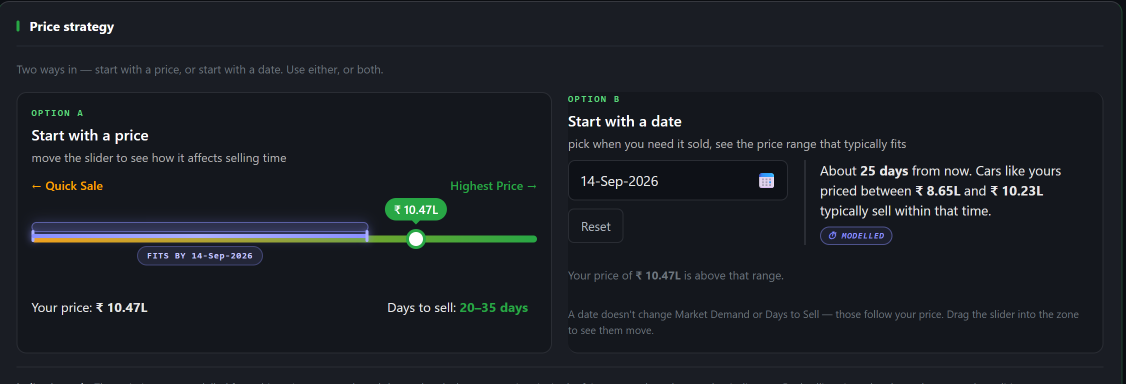
Pick a day, and the prices that fit it light up on the slider. One car, one date — yours will look different.
Put in the day you need the car gone. Three things happen at once.
A band lights up on the slider. It is tagged with your date. Those are the prices that get the car gone by then. Everything outside it does not.
You get the same thing in plain words. Cars like yours, priced between this and that, usually sell inside that time. The band and the sentence are saying the same thing twice, in two languages.
It checks where you are standing. If your slider is parked outside the band, it tells you so, in one line. That single sentence is the whole difference between wondering why nothing is happening and knowing exactly why.
That last one is the part most sellers never get. You can be asking a perfectly reasonable price and still be sitting outside your own deadline — and nothing on earth will tell you, because buyers do not write back to say "you are close, just not close enough."
Why a band, and not one exact price? Because one exact price would be a guess dressed up as a fact.
Nobody knows who will be looking for a car like yours next Tuesday. What can honestly be said is the stretch of prices that usually move a car like yours by that day. So that is what lights up.
Notice the days are a band too. Not "27 days." A spread. Same reason — a single day would just be a guess with a confident face on it.
And sometimes the answer is no. If your date is too soon, it says so — at any price. Nothing you can do with the slider will fix it. That is worth knowing on day one rather than in week three.
The ⏱ MODELLED tag. You will see it under the answer. It is there on purpose. It means this comes from a model of how cars like yours behave — not from confirmed sales of your exact car on your exact date. We would rather label the working than hide it.
Try two dates, not one
Put in a date three weeks away. Then put in that same date plus one month. Watch how far the range moves.
That gap is what your hurry costs you.
Some people find it is small and stop worrying about the deadline entirely. Others find it is big and quietly decide the move can wait a fortnight. Both are good outcomes. Neither one is available to somebody who never checked.
The short version
| If you start with… | You get | What happens |
|---|---|---|
| A price | A figure, no end date | You drift, and waiting costs you |
| A date | The prices that fit that day, lit up | You choose, and you can see the trade |
| A made-up date | Neither | Same as having no date |
Why this matters to us at AutoKnowMus
Notice what we are not doing. We are not telling you when to sell. There is no "sell now" button on AutoKnowMus and there never will be.
You bring the date. It is your move, your money, your reasons — and you are the only person who knows any of them.
What we do is the maths on your car and hand it straight back: here are the prices that make that day happen, and here is when no price will.
We do not buy cars. We do not sell them. We do not list them. We take nothing from your deal. That is exactly why we can give you the price straight — the same figure for the buyer and for you. Here is how we work it out. The verdict is never for sale.
You pick the day. We tell you what the day costs.
FAQs
How do I sell my car by a certain date?
Why can I not just fix the price and the date together?
Why does a date give me a band of prices instead of one price?
Does selling faster always mean getting less?
What if I do not really have a deadline?
Should I tell the buyer my deadline?
My date has already slipped twice. Does that matter?
What if my price is outside the band?
Does AutoKnowMus tell me when to sell?
Pick the day first. See which prices fit it, and let the price move around the date instead of the other way round.
Next — #03: Throw away the price in your head. It came from a neighbour, a service centre, or a website you scrolled once. It feels like yours. It is not.