Most people think a car is sold on the day somebody comes to see it. It is not. These days the price is settled days earlier, in a WhatsApp chat, in writing, usually late at night — before the Buyer has touched the car. Every message you send in that chat is evidence. It can be saved, screenshotted and forwarded. The Seller who replies with feelings — anger, hurt, "I paid much more than that" — gives ground with every message. The Seller who replies with facts — the car's details, its fair range, its papers, and a calm invitation to inspect — holds it. Send your range before they send their number. Keep your lowest price out of the chat. And let the facts do the talking.
What this post covers
Why the real bargaining over your car now happens on your phone. The five messages every Seller gets, and what each one actually means. The seven things that make a chat go wrong. The four parts of a reply that holds your price. The listing your dashboard writes for you, which opens the chat with the evidence already on the table. And a reply builder near the end that writes one for your situation. If you have not read them yet, throw away the price in your head and sell to a date, not to a price sit underneath this one. For bargaining face to face, see the negotiation playbook.
It is 10:47 at night.
The house is quiet. The television is off. You are about to put the phone down.
It buzzes.
"Last price?"
No hello. No name. Not a single question about the car. Two words, from a number you have never seen.
You start typing. You stop. You delete it. You start again.
One voice in your head says: who sends a message like that at this hour?
Another voice, quieter, says: what if this is the only person who ever asks?
And whatever you type in the next sixty seconds will decide more about your final price than anything you say on the day the car is finally seen.
You will not know that yet. Almost nobody does.
The haggling moved into your pocket
When I started in this trade, bargaining was a face-to-face sport. Two people, one car, a lot of hand-waving, a cup of tea, and a number agreed before the tea went cold. Nothing was written down. Half of what was said was forgotten by evening.
That world has gone. Today the bargaining starts on WhatsApp, days before anyone sees the car. And WhatsApp is not just a faster way of talking. It changes the rules in three ways nobody warns you about.
It is written. Every word stays. The "I will not go one rupee lower" you typed at midnight on Tuesday is still sitting there on Saturday, when you need to go lower.
It is copied. The person asking "last price?" has very likely sent the same two words to ten other Sellers in the last ten minutes. You think you are in a conversation. You are actually in a line, being compared.
It is cold. The Buyer cannot see your car. They cannot see the service file, the clean seats, or the care you took for five years. They can only see what you type. In that chat, you are the car.
So stop thinking of it as a chat.
Think of it as a courtroom.
The judge does not care how much you love the car. The judge does not care what you paid for it, or how badly you need the money. The judge weighs the evidence on the table, and nothing else. Your job is simple, and almost nobody does it: put good evidence on the table — calmly, in writing — before the other side puts theirs.
Whoever names a number first sets the starting point
The first figure in a chat becomes the one everybody argues around. If the Buyer drops a low figure first, you spend the whole chat dragging them up from it. If you put your fair range in first, the chat happens inside your range instead. Same car. Same Buyer. Different starting point.
The five messages every Seller gets
In all my years in this trade, I have seen the same five messages again and again. The words change a little. What they mean never does.
Learn these five, and you will never be surprised by a car chat again.
1. "Last price?"
What it really means: "How desperate are you?"
It is not a question about the car. It is a test of the Seller. If you answer with a single number straight away, you have answered the real question too: yes, I will move, and quickly.
Reply with: the car in one line, and your fair range. Not one "last" figure. The range is your answer.
2. A low number, and the word "final"
What it really means: "Maybe you will bite."
It is fishing, not an insult. Nobody throws a net and expects every fish in the river. They throw it at many Sellers and see who bites. You do not get angry at a fisherman. You just do not bite.
Reply with: a polite no, and your range again. Short. No lecture. Leave the door open for a serious figure.
3. "I need to inspect before I can quote."
What it really means: "Let me find faults first, then I will quote low."
This one usually comes from a Dealer, and it sounds perfectly reasonable — which is exactly why it works. You spend a Saturday morning washing the car. They spend twenty minutes pointing at scratches. Then a figure arrives that has nothing to do with the car you described.
Reply with: "Happy for you to inspect." Then ask for an indicative offer range before fixing the time, and share your fair range in return. If their range is close to yours, book it. If it is far away, you have saved a Saturday.
4. "I have seen cheaper ones online."
What it really means: "Prove yours is worth more."
And you know what? There will always be a cheaper one online. Always. Ads show what Sellers hope for, not what cars actually sold for — and a cheaper ad often has a reason it is cheaper.
Reply with: what makes your car different, in facts. Kilometers. Owners. Service record. Not adjectives. Do not argue with their screenshots. Put your evidence next to them.
5. "Can you come down a little?"
What it really means: "We are close. Show me you will move."
This is the only one of the five that is actually good news. It means a real person has done their sums and wants your car.
Reply with: one small step, inside your fair range, said once — "I can meet you at this, and that is the most I can move." Then stop typing.
Never type your lowest price into a chat
Your lowest acceptable price — your floor — is for your own planning, decided at home, with a clear head. The moment it appears in a chat, it stops being your floor. It becomes their opening offer. And it will be forwarded.
Seven reasons car chats go wrong
When a part comes off a factory line broken, nobody shouts at the part. They walk back along the line and find the station that broke it. Every part is made by the same seven things: the people, the machine, the material, the method, the measurement, the management, and the environment around it all.
A bad car chat is made on exactly the same line. Here are the seven stations.
1. The person — you. Tired, hopeful, a little hurt. At night, after a long day, the part of you that typed "this car is like family" is wide awake, and the part that knows what the car is worth has gone to bed.
2. The machine — the phone. It is built for speed. Fast thumbs, instant replies, voice notes sent in a temper. There is no pause button between feeling something and sending it.
3. The material — what you can show. No fair range. No service record photographed and ready. No clear photos. A Seller with nothing to show can only talk — and talk is cheap in a chat.
4. The method — how you reply. One bare number with no reason behind it. Waiting for them to name a figure first. Answering every message instantly, and every message differently.
5. The measurement — what you compare offers against. The price in your head. The highest ad you saw one evening. What a neighbour says they got. None of these ever looked at your car.
6. The management — nobody planned the chat. You never decided your floor. You never decided which strength to lead with. You never decided what you will say to "last price?" — so you decide it at 10:47 at night, which is the worst possible time to decide anything.
7. The environment — everything around the chat. Late nights. Ten other Sellers getting the same message. A festival around the corner, a new model in the news. You cannot control any of it. But you can know it is there.
Look at that list again. Six of the seven are entirely in your hands. Only one is the market. The rest is preparation — and preparation is free.
The reply that holds your price
A fact-based reply has four parts. You do not need all four every time, but the strongest replies use most of them.
1. The car, in one line. Year, variant, fuel, kilometers, owners, city. It shows the Buyer you are organised, and it saves both of you three messages.
2. The fair value — and the range behind it. Your listing carries one price, set at your car's fair value. In the chat, talk about the range behind it: every car's honest price sits inside one. Quoting the range shows you know the market, without boxing yourself into a corner. Your Seller dashboard shows both for your exact car.
3. One reason, in facts. The single strongest true thing about your car. First owner. Full service record. Kilometers below most cars like it. One fact beats five adjectives, every single time.
4. An open door. "Happy to arrange an inspection for a serious offer close to this range." It says you are confident, not defensive. And it quietly filters out everybody who was only fishing.
Put those four together, and "last price?" gets a reply like this:
Hi — thanks for asking. It is a [year] [variant], petrol, [kilometers] km, first owner, [city]. Going by current market data, the fair range for this car is ₹[low]–₹[high]. Full service record available. Happy to arrange an inspection for a serious offer close to that range.
Read it again. Calm. Short. Every single line can be checked. There is nothing in it for the Buyer to push against — except the facts.
And facts do not get tired at 10:47 at night.
Why a shared range ends arguments faster
A Buyer who looks up the same car on AutoKnowMus sees the same fair range you see — not a higher one for Sellers and a lower one for Buyers. So when you quote your range, you are not quoting your opinion. You are quoting a number both of you can check for yourselves. That is the difference between an argument and a conversation.
Every chat trades three things
Every car chat, from the first "hi" to the handshake, trades three things.
The quality of the deal — the price you finally get.
The cost of the chat — your time, your evenings, your nerves, the Saturdays spent on visits that go nowhere.
The delivery — how soon the car is actually gone.
Here is the hard truth: you can choose any two. The third gets chosen for you.
Want the best price and a quick sale? It will cost you — many chats, many calls, many visits, a lot of patience.
Want a quick sale and an easy chat? Then the price is what gives. That is the Dealer who takes your car in one visit, at their figure.
Want the best price and an easy chat? Then time is what gives. You wait for the one right Buyer, and you wait calmly.
Every one of those is a fair choice. The only bad one is not knowing which you made. Decide your two at home, before the phone buzzes — and every reply you send will point the same way.
Write these three lines before you post your ad
My fair range: ______ to ______.
My floor (private, never typed in a chat): ______.
The one true fact I will lead with: ______.
Three lines. Two minutes. They will save you more money than any clever reply you think of at midnight.
Your opening move, written for you
Here is something the best negotiators in this trade have always known: the chat is won or lost before it starts. Their very first message already carries the evidence. By the time the Buyer types "last price?", there is very little left to argue about.
That is exactly what the ready-to-post listing on your Seller dashboard does. Scroll down past your price and the market panels, and you will find a box called The listing you'll post.
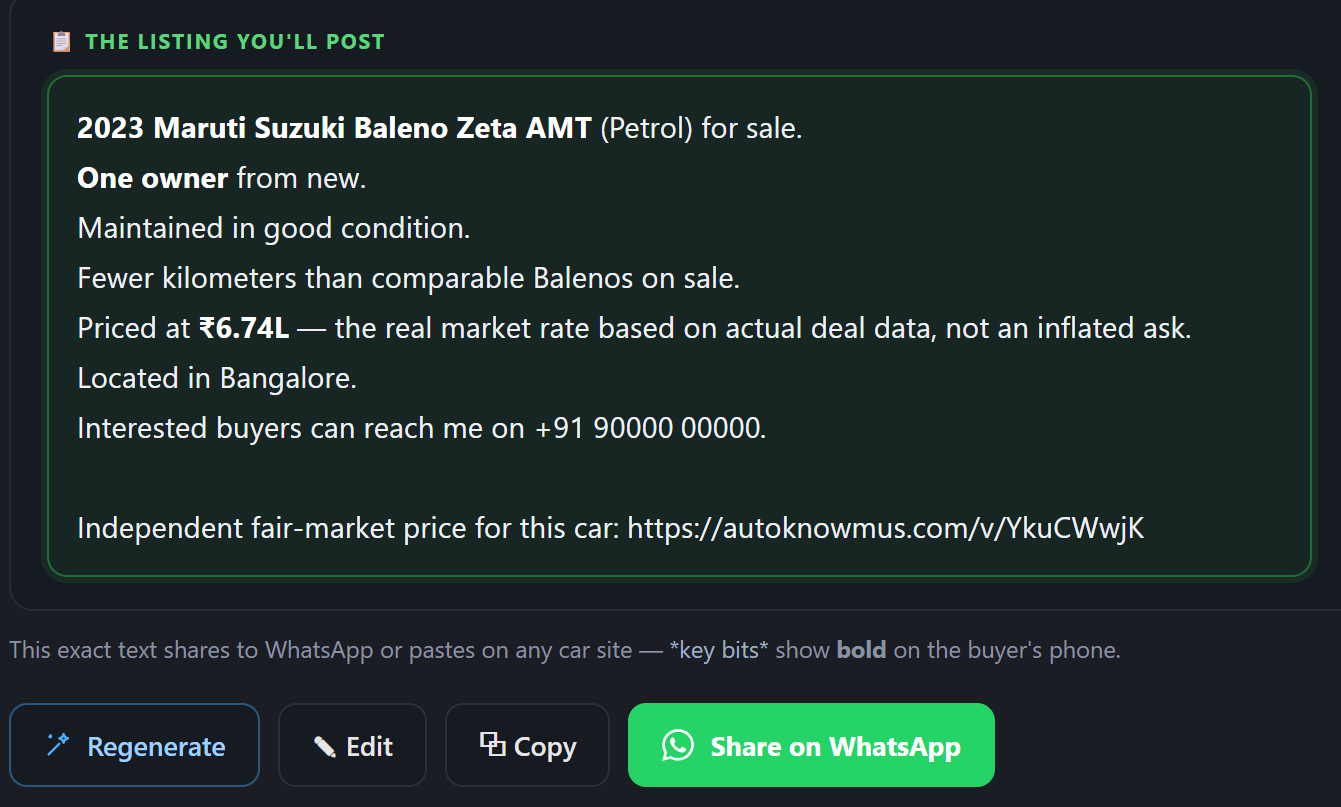
One car's listing, shown with a placeholder phone number. Yours is written from your own car's facts.
Read it line by line, and you will see every rule in this post already at work.
The car, in one line. Year, make, model, variant, fuel — with the key words in bold. No "urgent". No "like new". Just what the car is.
Only the strengths that are true. One owner from new. Fewer kilometers than comparable cars on sale. The listing checks your car against cars like it, and claims a strength only when the data agrees. If your kilometers were higher than most, that line would simply not be there. No spin. No "well driven". Nothing a Buyer can catch you out on later.
The price, with its reason attached. Your fair value — and one line saying where it came from: the real market rate based on actual deal data, not an inflated ask. Most Sellers spend twenty messages trying to say that. Here it is said once, before anybody asks.
The proof, one tap away. The last line is a link to an independent fair-market price for your exact car. When a Buyer wonders "says who?", they do not have to take your word for it. They can tap, and check for themselves — and they will find the same figure you see, because there is only one.
That last line changes the whole chat. You are no longer a Seller defending a number. You are a Seller showing one.
Four buttons, one rule: the facts stay the facts
Regenerate. Not happy with the wording? Tap it for a fresh version — same facts, new words. Try a few, and keep the one that sounds most like you. Rewrites are free once your listing is created, so there is no reason to post a version you do not like.
Edit. Add what only you know — a full service record, new tyres, the best time to call. Keep the same rule as the rest of the listing: if a Buyer cannot check it, leave it out.
Copy. Paste the exact text on any car site, word for word.
Share on WhatsApp. The listing opens in your own WhatsApp, ready to send to a Buyer, a Dealer or a group. The key words arrive in bold on their phone, so it looks sharp, not like a flat block of text.
It is your listing and your chat — not ours
AutoKnowMus does not send anything on your behalf, and we never see the replies. Your phone number goes only into your own listing, so Buyers can call you directly. And the price in it is your fair value — the same one any Buyer sees for the same car. The listing will not help you pitch above it, and it will not talk you below it.
Six questions before you hit send
Ten seconds. Every reply. Especially the late-night ones.
What did they actually ask — a price, a move, or permission to inspect?
Why are they asking it this way — testing, fishing, or genuinely close?
Who is on the other side — a private Buyer, or a Dealer messaging ten Sellers at once?
When am I replying — calmly, or in the heat of the moment? A reply sent ten minutes later loses nothing. A reply sent in anger can lose everything.
Where does my reply sit — inside my fair range, or have I drifted outside it without noticing?
How would this message look if they forwarded it to someone else?
If the last answer makes you wince, rewrite it before you send it. They will forward it.
Six things a reply that holds your price has
Polite — no anger, no sarcasm, even at a lowball.
Paced — sent calmly, not in the first second.
Precise — a range from your car's facts, not a round guess.
Proof — one fact the Buyer can check.
Private — your floor stays at home.
Plain — short enough to read on a phone in one glance.
Scroll back through your last car chat. Count how many of your replies had all six.
Build your reply
Pick the message you just received. Fill in your car's details and the fair range from your Seller dashboard. The builder writes a calm, fact-based reply. Change anything you like, then copy it or open it straight in WhatsApp. Nothing is sent or saved.
Build your reply
Amounts in rupees, digits only. No sign-up. Nothing is saved.
This builder only writes words. It never suggests a price outside the fair range you enter — and it cannot tell you what your car is worth. Your Seller dashboard does that.
The short version
| The message | What it really means | Reply with |
|---|---|---|
| "Last price?" | "How desperate are you?" | The car in one line, and your fair range |
| A low number + "final" | "Maybe you will bite" | A polite no, and the range again |
| "Need to inspect first" | "Let me find faults, then quote low" | An offer range before the visit |
| "Seen cheaper ones online" | "Prove yours is worth more" | One true fact, not adjectives |
| "Come down a little?" | "We are close" | One small step, inside your range, once |
One line holds the whole table together: every good reply is about the car. Every bad reply is about you.
Why this matters to us at AutoKnowMus
Every car chat starts with the same problem. Two strangers. One car. And no shared idea of what it is worth. So each side argues from feelings, and somebody walks away feeling cheated.
We built AutoKnowMus to put one fair range on the table — the same figure for the Seller and the Buyer, worked out from the car's own facts: make, model, year, variant, owners, kilometers and condition. Here is how we work it out. When both sides can check the same range, the courtroom finally has evidence in it.
We do not buy cars. We do not sell them. We do not list them. Not one rupee of ours moves when your deal closes. We never send messages on your behalf, and we never see your chats. The verdict is never for sale.
Bring evidence to the courtroom. Leave the feelings at home.
FAQs
How should I reply when a Buyer messages "last price?" on WhatsApp?
Should I tell the Buyer my lowest price?
A Dealer wants to inspect the car before quoting. Should I agree?
How do I handle a very low offer without losing the Buyer?
Is it a good idea to negotiate a used car sale over WhatsApp?
What is the ready-to-post listing on the AutoKnowMus Seller dashboard?
Can I change the wording of the listing?
Open your last car chat — or the one waiting on your phone right now. Count the replies that were about the car, and the ones that were about how you felt. Then get your car's fair range, write your three lines, and send the next reply with facts.
Next — #09. You know what your car is worth, and how to say it. Next, one more thing every Seller should check before the first Buyer arrives.