After selling your car, you hold the rarest number in the used-car market: the price it actually sold for. Asking prices are everywhere. Real selling prices almost never get written down anywhere, because Sellers keep them to themselves. Reporting yours takes a few minutes and pays you first: it earns Credits that cover fair-value checks and deal alerts for your next car, it tells you whether you sold well, and — with proof — it becomes a verified deal that makes every fair range sharper, including the next one you check. On AutoKnowMus there are two ways to do it: Submit a verified deal, the full form with a proof upload, or the quick "Was this estimate helpful?" box on your Seller dashboard. Keep one piece of proof from the hand-over — a delivery note, a receipt or the payment message — and report within days, while the exact price is fresh. Then finish the short paperwork: a dated delivery note, and Form 29 to the RTO within 14 days.
What this post covers
Why your final price is worth more than you think, and seven reasons reporting it pays you. The two ways to report it on AutoKnowMus, and the "Submit a verified deal" page field by field — what each part asks, why it asks, and the Credits it earns. What happens after you press Submit. The short paperwork list that protects you, with the official forms, a QR code to share them at the car, and a delivery note you can fill in and print. Six questions before you report, seven ways a deal report goes wrong, and a Hand-Over Checklist near the end that gets your report ready. If you have not read them yet, don't wait blind sits right before this one, and asking price isn't selling price explains why this number is so rare.
It is Saturday. 6:15 in the evening.
The Buyer has just driven away in your car.
You stand at the gate with your phone in your hand. On the screen, the payment message. The number on it is the number you worked three weeks for.
You walk inside. You make tea. You tell the family.
And then the number disappears.
Not from your bank account. From the world.
Nobody writes it down. No website shows it. Next month, somewhere in your city, another Seller with the same car will open their phone, look at a dozen asking prices, and guess. They will not see your number. It will be as if your sale never happened.
You just did all the hard work of finding out what your car was really worth.
And then you kept the answer to yourself.
The rarest number in the used-car market
I have been in this trade a long time, and here is the thing that still surprises me: the most valuable number in the whole used-car business is the one almost nobody shares.
Asking prices are everywhere. Open any app and you will see hundreds of them. But an asking price is a wish. It is what a Seller hopes to get. Some of those cars sell close to it. Many sell well below it. Some never sell at all.
A selling price is different. It is the number two strangers actually agreed on, after all the calls, the visits, the tyre-kicking and the bargaining. It has been tested from both sides. It is a fact.
And it vanishes the moment the car leaves the gate.
Think about what that means. The whole market is trying to work out what cars are worth by looking at wishes. The one thing that would settle every argument — what cars actually sold for — sits in a few thousand payment messages on a few thousand phones. Yours is one of them.
You are not just a Seller who finished a sale. You are holding a piece of the answer everyone else is looking for.
Your price is like the mandi rate
A farmer does not guess what onions are worth. They check the day's rate at the mandi — the price produce actually went for that morning. That rate exists only because every trader's sale gets written on the board. Take the board away, and every farmer goes back to guessing. Your selling price is one line on that board. Leave it blank, and the next Seller guesses.
Seven reasons to report your deal — and only the last one is about other people
Most posts will tell you to report your price "to help others". That is true, and we will get to it. But I want to be straight with you: reporting your deal pays you first. Here is how.
1. You get paid for it. Submitting a deal earns Credits on AutoKnowMus — 100 for the deal, or 1,000 when your email is verified and the sale happened within the last year. Share your asking price and it is +50. Fill in the service history, accident history and insurance status and it is +50 each. Add your next car plan, your timeline and why you sold and it is +25 each. Upload proof, and once it is approved, it is +3,000 more. One complete report with proof can earn you over four thousand Credits.
2. Those Credits pay for your next car's homework. Most Sellers become Buyers within months. On AutoKnowMus, checking a car's fair value costs 100 Credits, and a month of deal alerts costs 500. One complete, proven deal report pays for dozens of checks on the next car you are thinking of buying — or many months of alerts while you shop.
3. You find out if you sold well. Report through the "Was this estimate helpful?" box and tick "This was a real deal I was part of.", and the box tells you how your price compared with the estimate — right in line, or roughly how far above or below. For the first time, you know for sure whether you left money on the table or drove a good bargain.
4. You unlock your Resale Value Check. Sharing your feedback in that same box unlocks the Resale Value Check just below it. It shows how the car you are thinking of buying next is likely to hold its value — before you spend a rupee on it.
5. One sheet of paper protects you twice. To prove your deal, you keep a signed, dated delivery note. That same sheet is what protects you if a challan arrives in your name after the sale. Reporting builds the habit of keeping it — and the habit is what saves you.
6. Every fair range you check later gets sharper. The next time you, your brother or your neighbour value a car like yours on AutoKnowMus, the range is blended with verified real deals. Yours is one of them. You are not just giving a price away — you are making the tool you will use again more accurate for your own city and your own kind of car.
7. The next Seller and Buyer start from a fairer price. Someone with a car like yours is sitting where you sat three weeks ago, guessing. Someone else is about to pay for one, wondering if they are being taken for a ride. Your number tells both of them the truth — the same number, because AutoKnowMus shows one fair range to both sides.
Think about the traffic line on the map in your phone. Red means slow, green means clear. Nobody stands on the road with a clipboard. The line is true only because thousands of phones quietly report how fast they are moving. Take the phones away, and the map goes back to guessing.
A fair range for used cars works the same way. The formula gets close, from the car's own facts. Real deals are what make it sharp. On your Seller dashboard, the AutoKnowMus Verdict even tells you how many verified real-world deals your range was blended with. Every deal you report moves that number for the next person.
The loop only turns if step two happens. Skip it, and the next Seller starts with one deal less than you had.
Two ways to report your deal
There are two doors on AutoKnowMus. Both lead to the same place. One is quicker. The other counts for more.
| The quick box | Submit a verified deal | |
|---|---|---|
| Where | "Was this estimate helpful?" on your Seller dashboard | The "Record Your Transaction" page |
| Time | About a minute | About five minutes |
| What it asks | Helpful or Way off, the actual price, source, buying timeline | The car, the registration number, the dates, who bought it, both prices, and proof |
| Proof | We check with you over a quick WhatsApp | You upload it yourself |
| Best for | When you valued the car on AutoKnowMus first | When you have a delivery note, receipt or payment record |
If you have proof, use Submit a verified deal. It is the door that turns your price into a fact the whole market can lean on.
Submit a verified deal, field by field
You will find the link at the bottom of the "Was this estimate helpful?" box on your Seller dashboard: Submit a verified deal. It opens a page called Record Your Transaction. Here is every part of it, in the order you will meet it, and why it is there.
Where the deal happened. The state and city. A car sells for different amounts in different places — road tax, demand and supply all change by state — so the place is part of the price.
The car. Make, fuel, model, variant, year, number of owners, kilometers and condition. These are the same facts your fair range was built from, so your deal can be compared like for like. Use the kilometers at the moment of hand-over, not the number from three months ago.
The registration number. This one makes people nervous, so let me be clear about why it is there. It is used to make sure the same car is not counted twice — once by you and once by someone else, or twice by you. It is never shown to anyone in deal alerts or fair ranges.
The transaction date. The day the car changed hands. A deal from this month tells the market about this month.
How long the car was on the market. From under a week to over three months. This is the quiet number that tells the next Seller how much patience a car like theirs needs.
Transaction type — Dealer or private. Who bought it. A Dealer pays less than a private Buyer, because the Dealer has to resell the car and earn something. Mixing the two would bend the fair range, so the page keeps them apart. Dealer deals need proof.
Asking price. Optional, but share it. The gap between what you asked and what you got is the size of the negotiation — one of the most useful numbers in this trade. It tells the next Seller how much room to leave, and the next Buyer how much room is usually there. Sharing it earns extra Credits.
Final negotiated price. The exact number that changed hands. Not rounded. Not the first offer. Not the asking price. The box puts in the commas for you as you type.
Proof. Upload a photo or PDF of an invoice, a receipt, the delivery note or an RC copy — JPG, PNG, WEBP or PDF, up to 5 MB. Then tick "I confirm I have documentation for this transaction". The proof is reviewed by hand, and once it is approved you earn a big proof bonus on top. This is the field that turns a reported price into a verified one.
Optional extras. Service history, accident history, insurance status, your next car plan, your purchase timeline and why you sold. Each one adds a little more meaning to your deal — and each one earns a few more Credits.
What reporting earns, as shown on the page today
Submitting the deal: 100 Credits — or 1,000 Credits when your email is verified and the deal is a real, recent sale (within the last year).
Sharing your asking price: +50 Credits.
Service history, accident history, insurance status: +50 Credits each.
Next car plan, purchase timeline, reason for selling: +25 Credits each.
Proof approved: +3,000 bonus Credits.
The page shows the exact Credits next to each field, so you always know what you are earning. You can submit up to three deals in thirty days.
Never report a rounded or hopeful number
If your car sold for a little under a round figure, report the little-under figure. A rounded price, an asking price passed off as a selling price, or a price "plus accessories" without saying so does more harm than no price at all — because the next Seller trusts it. Report exactly what happened.
The quick way: "Was this estimate helpful?"
No proof handy, or short on time? Open your Seller dashboard for the car you sold and scroll to the bottom. Next to the AutoKnowMus Verdict — below it on a phone — is this box.
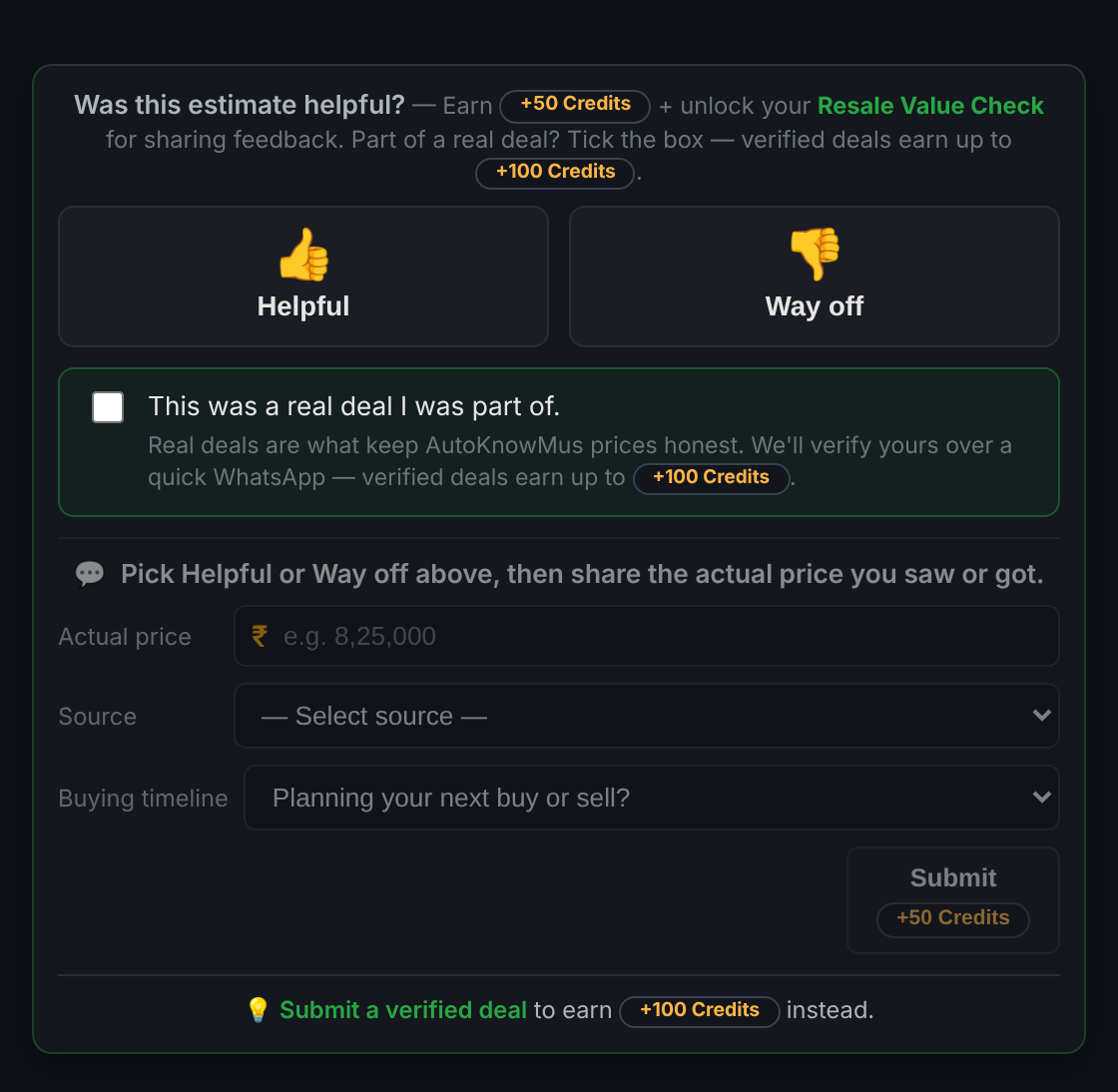
The "Was this estimate helpful?" box, as it sits next to the AutoKnowMus Verdict, before you pick a button.
Pick Helpful or Way off — both count the same, and a Way off with a real price behind it teaches the estimate just as much. Type the actual price, choose the source and your buying timeline, and tick "This was a real deal I was part of." That tick is what turns your answer into a real deal. We check it with you over a quick WhatsApp. When it goes through, the box shows how your price compared with the estimate — right in line when it is within a few percent, or roughly how far above or below it landed. You can leave feedback once for each valuation; if you gave feedback earlier and only now closed the deal, tick the box and submit again so the deal still gets recorded.
What happens after you press Submit
Your Credits land straight away. Your deal is saved against the car's make, model, variant and year — never against your name.
If you uploaded proof, it is reviewed by hand. Once it is approved, the proof bonus is added, and your deal becomes one of the verified deals the fair range is blended with. That is the moment your price starts working for everyone else — every Seller and Buyer who checks a car like yours from then on is looking at a range that your sale helped make true.
What reporting shares — and what it never does
When you report a deal, the market learns about the car and the price: make, model, variant, year, kilometers, owners, condition, the price and roughly when. It never learns about you. Deal alerts and fair ranges never show who sold, who bought, a phone number, an address or a registration number. The price goes into the pool. Your name does not.
And the paperwork? One short list.
Before you report, close the legal side so the sold car cannot come back to you. Until the registration is in the Buyer's name, the RTO's records still show you as the owner — so a challan can still arrive in your name. On the day of the sale, get a delivery note signed by the Buyer with the date and the hour of hand-over, and keep a copy of the Buyer's ID. Give Form 29 to the RTO within 14 days if the Buyer is in your state, or within 45 days, with a No Objection Certificate, if the car is going to another state (Section 50, Motor Vehicles Act, 1988); the Buyer then has 30 days to apply with Form 30. Hand over the insurance instead of cancelling it, close the FASTag on your account, and never sign a blank form. The full walk-through is in how to transfer car ownership. And here is the good news: the delivery note you keep for the law is the same paper that proves your deal. One sheet does both jobs.
Hand-over forms: everything to sign at the car
The official RTO forms, straight from Parivahan, the Government of India transport portal — plus a delivery note you can fill in and print. Print two copies of each: one for you, one for the Buyer.
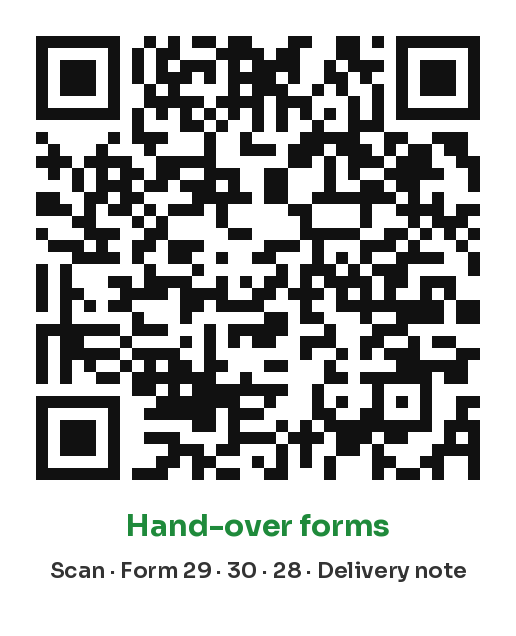 Scan at the car
Print this page or show the QR on your screen. The Buyer scans it to open the same forms and delivery note on their phone.
Make your delivery note
Fill in the details, tap the button, and a ready-to-sign delivery note appears below. Print it, or save it as a PDF, and both of you sign it. Nothing is uploaded or saved by AutoKnowMus.
Make my delivery note shows a ready-to-sign note with your details and spaces for both signatures, right below. Start over clears every field. A signed delivery note with the price on it is also the best proof for Submit a verified deal. This is a simple template, not legal advice.
Six questions before you report
Before you press Submit, run through these six. They take less time than the tea.
What, exactly, are you reporting? The final price that changed hands. Not the asking price, not the first offer, not the number you hoped for.
Why does it matter? Because the next Seller's fair range is built partly from deals like yours. A wrong number does more harm than no number.
Who bought it? A private Buyer or a Dealer. Say which. A Dealer pays less because they have to resell.
When did it close? Report within days, not months. A deal from this week tells the market about this week.
Where is the proof? The delivery note, a receipt, the payment message. If you have it, upload it — it is what turns your price into a verified deal.
How close was the estimate? Helpful or Way off — your honest answer, with the real price behind it. That is how the estimate learns.
Seven ways a deal report goes wrong
When a part comes off a factory line broken, nobody blames the part. They walk back along the line and find which station broke it. There are always seven stations: the person, the machine, the material, the method, the measurement, the management, and the environment.
A deal report that never happens — or happens wrong — comes off the same line.
1. The person — relief. The car is gone, the money is in, and you switch off. Reporting gets put off till "next week", and next week never comes.
2. The machine — the phone. The payment message and the photo of the delivery note get buried in a chat you will never scroll back to. Make an album for the sale the same evening.
3. The material — the proof. No delivery note, or one without a date. No photo of the receipt. Proof you did not keep is proof you cannot upload.
4. The method — the wrong door. Using the quick box when you have proof in your hand. If you have the paper, use Submit a verified deal.
5. The measurement — the wrong number. A rounded price. The asking price instead of the final price. The kilometers from last month. The market learns whatever you tell it.
6. The management — no reminder. Put one in your calendar for the day after the sale: "Report the deal." Two minutes, while you still remember everything.
7. The environment — the market itself. Busy months, slow months, new versions arriving at dealerships. You cannot control any of it — which is exactly why real prices from real sales matter so much.
Now count. Six of those seven are fully in your hands.
The best-paid five minutes of the whole sale
Every step in selling a car trades three things.
Quality — how good the result is.
Cost — what it takes from you in money, time and effort.
Delivery — how soon it is done.
Reporting your deal is the best trade in the whole journey.
Quality: a real price, with proof, that makes the fair range sharper for every Seller and Buyer after you.
Cost: about five minutes, one photo and the numbers you already know. And it pays you in Credits instead of costing you.
Delivery: today. The day of the handshake, while you still remember the exact price, the kilometers and the hour.
Six things every good deal report has
Prompt — reported within days of the handshake, not months later.
Precise — the exact final price, not a rounded guess or the asking price.
Paired — on the right car: the same make, model and variant, with the real kilometers at hand-over.
Party-named — says whether a private Buyer or a Dealer bought it.
Proven — backed by a delivery note, a receipt or a payment record.
Private — shares the car and the price, never anybody's name or number.
A report with all six is the most useful thing a Seller can give the next Seller.
Your Hand-Over Checklist
Just sold your car — or about to? This checklist gathers everything you need to report your deal, in the order you will need it. Put in the day of the sale and it adds the dates. Tick each item as you get it. When everything is ticked, your deal is ready to report. Everything stays on your phone. Nothing is uploaded or saved.
Hand-Over Checklist: everything you need to report your deal
Collect these at the hand-over, and your deal report takes five minutes. Nothing is uploaded or saved by AutoKnowMus.
Fill in my dates adds the report-by date and the Form 29 deadline from the day of the sale. Start over clears the date, the dropdown and every tick.
For your deal report
To protect yourself
0 of 8 ready.
Submit a verified deal opens the Record Your Transaction page (sign in first) — use it when you have proof. Report my price below takes you to "Just bought or sold a used car?" at the bottom of this page, a quick price check that also records your deal.
The dates are a guide, not legal advice — your RTO has the final word. The checklist cannot tell you what your car is worth. Your Seller dashboard does that.
The short version
| After the handshake | Do this | Not this |
|---|---|---|
| Your final price | Write down the exact number | Round it, or forget it |
| Your proof | Keep the delivery note, receipt or payment message | Leave it buried in a chat |
| Reporting, with proof | Submit a verified deal and upload the proof | Keep the price to yourself |
| Reporting, in a hurry | Use the "Was this estimate helpful?" box and tick "real deal" | Wait for "next week" |
| Your asking price | Share it — the gap teaches the next Seller | Leave it out |
| Who bought it | Say Dealer or private Buyer | Mix the two |
| The paperwork | Delivery note with the hour; Form 29 within 14 days | Hand over blank signed forms |
One line holds the whole table together: your car is gone, but its price is the last thing it can give — report it, with proof, and the next Seller starts where you finished.
Why this matters to us at AutoKnowMus
A used-car price is only as honest as the deals behind it. Everyone can see what Sellers are asking. Almost nobody can see what cars actually sold for — unless the people who sold them say so.
We built AutoKnowMus to put one fair range on the table — the same figure for the Seller and the Buyer, worked out from the car's own facts: make, model, year, variant, owners, kilometers and condition, and blended with verified real deals as they are reported. Here is how we work it out. Every deal you report, and every time you tell us how close the estimate was, makes that range a little sharper for the next person who needs it.
We do not buy cars. We do not sell them. We do not list them. Not one rupee of ours moves when your deal closes, whatever price it closes at. The verdict is never for sale.
Sold is not done. Done is when your price helps the next Seller.
FAQs
What should I do after selling my car?
Why should I report my car's selling price?
How do I report my car sale price on AutoKnowMus?
What counts as proof of a used car sale?
How many Credits do I earn for reporting a deal?
Will anyone see my name, number or registration number if I report my deal?
Why should I share my asking price as well as the final price?
What if the estimate was way off from my final price?
Where can I download Form 29 and Form 30 for selling my car?
Am I responsible for my car after selling it if the RC is not transferred?
Your car is sold. Its price is still in your hands. Open your Seller dashboard, tap Submit a verified deal, and leave your real price behind for the next Seller.
Next — #12: Twelve Things. One Verdict. The series finale: the AutoKnowMus Verdict, and the whole Seller dashboard from top to bottom — every panel from this series on one screen, and how to read them together before you sell.