While your car waits for the right Buyer, the only number that should move your price is what cars like yours actually sold for — not what other Sellers are asking, and not what the last caller offered. Asking prices are wishes. Selling prices are facts. Most Sellers wait blind: they panic after two lowball calls and cut their price, or hold on out of pride while the car loses value every week. On your AutoKnowMus Seller dashboard, the deal alerts strip emails you when a deal for the same make, model and variant is reported on AutoKnowMus, with the sale price, the car's year, kilometers, owners and condition, whether proof of sale came with it, and your car's own fair range beside it. Read each alert with six questions. Never move your price on one deal. When several like-for-like deals land in the same place, look again at your range.
What this post covers
Why waiting is where most Sellers lose money. The difference between an asking price and a selling price. The deal alerts strip on your Seller dashboard — what it does, what it costs, and what each email tells you. Six questions to ask of every closed deal, the seven ways waiting goes wrong, and the six things every good price signal has. And a deal signal reader near the end that checks any closed deal against your own car. If you have not read them yet, nine car photos that get your phone ringing sits right before this one, and what waiting costs you is where this series began.
It is Thursday. Day twelve.
Your ad has been up for almost two weeks. The photos are good. The words are honest. The price came from the car's facts, not from your heart.
Two people have called.
The first one said, "Final price?" and hung up when you said your range.
The second one came to see the car, walked around it once, kicked a tyre, and offered a number so low you laughed out loud after they left.
Now it is evening, and you are scrolling through other ads. A car like yours — same year, more kilometers — is up for much more than you are asking. Another one, a year newer, is up for less.
Your neighbour stops you at the gate. "Too high, yaar. Drop it. Cars are not selling these days."
Your brother-in-law says the opposite. "Don't give it away. Somebody will come."
You go to bed with one question going round your head.
Is my price wrong — or is it just the waiting?
Here is the honest answer. You cannot tell. Not from where you are standing. Every number you have looked at today was somebody's wish or somebody's bargain. Not one of them was a deal that actually closed.
You are waiting blind.
Waiting is where Sellers lose money
I have been in this trade a long time, and I will tell you something most Sellers never hear: the money in a car sale is not lost in the negotiation. It is lost in the waiting.
It is lost in two ways, and they are opposites.
The first Seller panics. Two weak calls, one rude offer, a neighbour's comment — and on day ten, they cut the price. Then they cut it again. They sell to the next person who calls, below the car's fair range, and later find out cars like theirs were closing well above it.
The second Seller is proud. They decided their number on day one, and they will not move. Weeks pass. The odometer keeps turning. The registration year gets one year older on the calendar. By the time they finally sell, the car is worth less than the price they turned down two months ago.
Both Sellers made the same mistake. They made their decision without the one number that matters — what cars like theirs actually sold for.
A farmer does not guess the price of onions
Before a farmer loads the truck, they check the day's rate at the mandi — the price the produce actually went for this morning, not the price the trader across the road is shouting. They do not sell at the first offer. They do not hold the crop until it rots. They watch the rate, and they move when the rate tells them to. Selling a car is the same. Watch the rate. Not the shouting.
Asking price is a wish. Selling price is a fact.
This is the heart of the whole post, so let me say it plainly.
Every car ad you scroll past shows an asking price. That is what the Seller hopes to get. It says nothing about what they will get. Some of those cars will sell close to it. Many will sell well below it. Some will sit for months and never sell at all — and you will never know, because a car that does not sell simply stays up.
A selling price is different. It is the number that changed hands, between a real Seller and a real Buyer, for a real car, on a real day. It is the only price that has been tested by both sides.
When you compare your car to other ads, you are comparing your wish to other people's wishes. That is why the comparison never settles anything. One ad makes you feel cheap. The next one makes you feel greedy. Neither one is evidence.
If you want the longer version of this, asking price isn't selling price walks through the four things an ad can never show you.
The short version: stop reading ads to set your price. Start watching deals.
Never cut your price because of a lowball call
A lowball offer is not information about your car. It is information about that caller. Some callers offer low to every Seller, every time, just to see who blinks. If you drop your price after one rude offer, you have not learned anything about the market. You have only rewarded the person who tested you.
The deal alerts strip on your Seller dashboard
This is where your Seller dashboard helps you wait with your eyes open.
Scroll down past your ready-to-post listing and the photo guide. Just before the AutoKnowMus Verdict, you will find a strip that says:
Subscribe for deal alerts — Avoid the waiting game to sell at your price. Know real market prices based on buyers' verified transactions on AutoKnowMus.
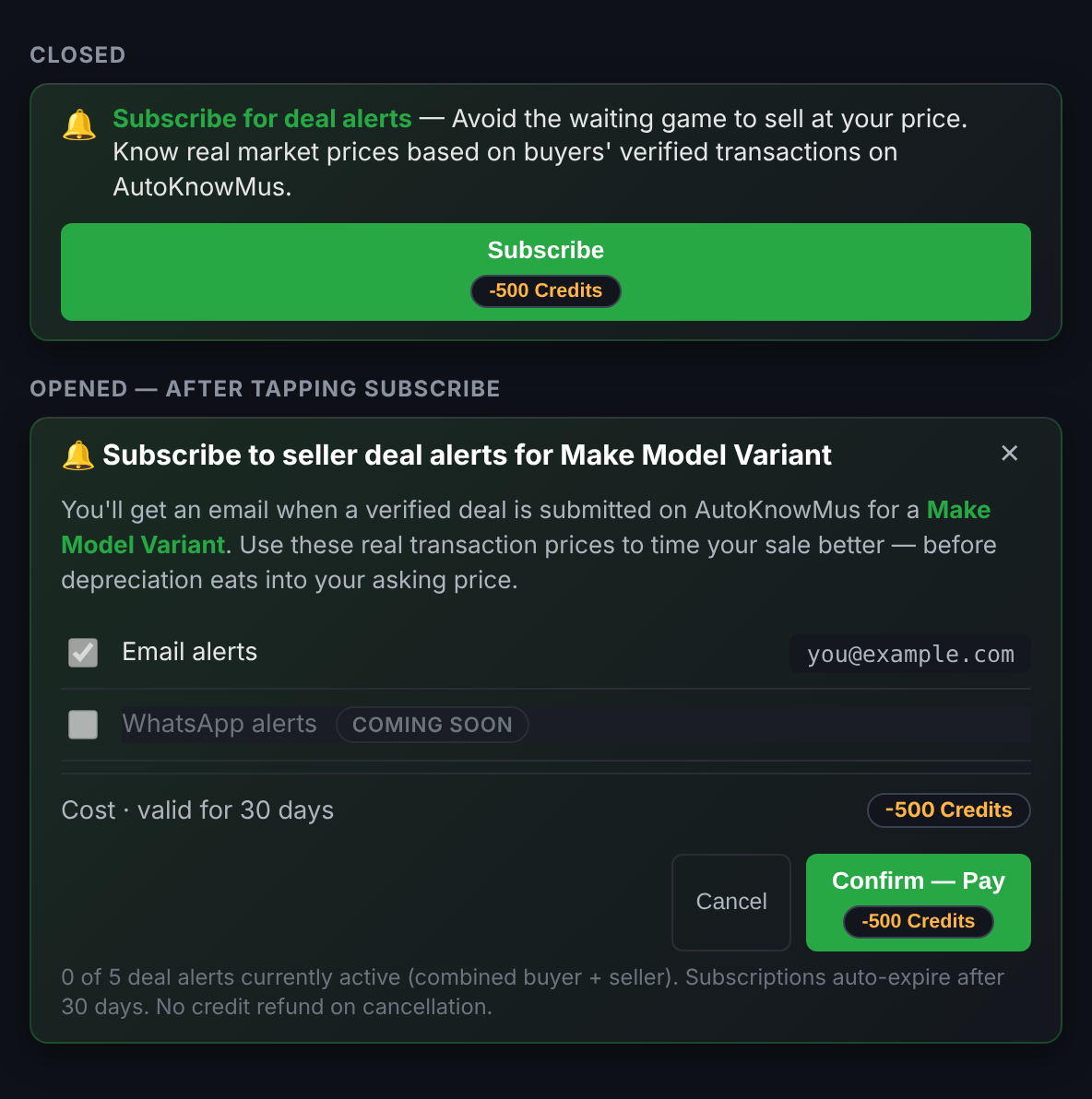
The deal alerts strip, closed and opened, shown with sample details. One tap to open it, one tap to confirm.
Here is what each part means, and how to use it.
The Subscribe button. It shows the Credits the alert costs, right on the button. Tap it and the strip opens — nothing is charged until you confirm.
"Subscribe to seller deal alerts for" your car. The alert is set for your car's exact make, model and variant — the same car your fair range was worked out for. You do not need to type anything. The strip already knows your car from your dashboard.
Email alerts. Always on. The alert goes to the email address on your AutoKnowMus account.
WhatsApp alerts — Coming Soon. Not live yet. For now, alerts come by email only.
Cost · valid for 30 days. One subscription lasts thirty days, then it ends on its own. Nothing renews behind your back. If you are short of Credits, the strip changes to show how many you need, with a button to top up your Credits for free.
Confirm. Tap it and the strip turns into a green line: Email deal alerts active for your car, with the date it runs until.
Two house rules sit underneath. You can have up to five deal alerts running at once, across all your cars — as a Seller and as a Buyer together. And you can cancel any alert from the strip or from your alerts page at any time; the slot is freed, though the Credits are not refunded.
What an alert email tells you
When somebody reports a deal on AutoKnowMus for a car with the same make, model and variant as yours, you get an email. Its subject line starts with "Market signal", and it tells you that a car like yours just sold.
Inside, you will find:
The sale price — the number that actually changed hands, and the date.
Who bought it — a private Buyer or a Dealer. This matters more than most Sellers think, and I will come back to it.
The deal car's facts — its year, fuel, kilometers, condition and owners.
What you subscribed for — your own car's year, fuel, owners, condition and kilometers, right beside it, so you can compare like with like.
What this means for your car — your estimated value and your fair market range, worked out the same way as on your dashboard.
And two honest notes, when they apply.
If the deal car is from a different year than yours, the email says so, so you do not compare a newer car with an older one by mistake.
If the deal was reported without proof of sale, the email says that too, in plain words: use it as a direction, not a confirmed benchmark. That one line is worth more than the whole email. It is telling you how much weight to put on what you just read.
To keep your inbox calm, you will get at most one alert email every six hours for the same car.
What the alert never shares
An alert tells you about the car and the deal — never about the people. You will not see who sold it, who bought it, their phone number or their city address. And nobody who receives an alert about your car's type will ever see yours. The market learns the price. Nobody learns the person.
One deal is a rumour. Three deals are a pattern.
Here is the part where most people go wrong, even with good information in their hands.
The first alert lands. A car like yours sold for less than your asking price. Your stomach drops. You reach for your phone to edit your ad.
Stop.
One deal is one deal. Maybe that car had a dent. Maybe the Seller had a flight on Monday and needed the money on Saturday. Maybe it went to a Dealer, who always pays less than a private Buyer because they have to resell it and earn something. Maybe it was reported without proof, and the number is not even exact.
One deal is a rumour. Three like-for-like deals landing in the same place — that is a pattern. And a pattern is something you can act on.
Thirty days of alerts. The hollow dots pull your eye, but the solid dots tell the story — and they are sitting inside your fair range.
Look at what happened in that picture. The first alert was alarming — a deal far below the range. But it came without proof, and nothing else landed near it. The proven, like-for-like deals that followed all closed inside the fair range, a little under the asking price. The Seller who cut their price on day three would have given money away. The Seller who waited and watched learned that their price was fine — and that a small step towards the middle of the range, if they ever needed it, was all the market was asking for.
Six questions to ask of every alert
Every time a "Market signal" email lands, read it with these six questions before you touch your price.
What car, exactly? Same year? Similar kilometers? Same number of owners? Same condition? The closer the match, the more the deal tells you. A car one year apart or with far more kilometers is a cousin, not a twin.
When did it close? A deal from this week tells you about this week's market. The fresher the deal, the more it matters.
Who bought it? A private Buyer or a Dealer. A Dealer buys to resell, so they pay less to leave room for their own costs and margin. A Dealer price below your range does not mean a private Buyer will pay that. Compare private with private.
Where is the proof? Was the deal reported with proof of sale? If the email says it came without proof, treat it as a direction — useful, but never the thing that moves your price on its own.
Why might it be different? Is there anything in the deal car's facts that explains the price — poorer condition, an extra owner, a lot more kilometers? If you can explain the gap, the gap is not about your car.
How many like it? Is this the first deal of its kind you have seen, or the third that landed in the same place? One deal, you note. Several deals in the same place, you act on.
Seven ways waiting goes wrong
When a factory turns out a broken part, nobody shouts at the part. They walk back along the line and find which station broke it. There are always seven stations: the person, the machine, the material, the method, the measurement, the management, and the environment.
A sale that goes wrong while you wait comes off exactly the same line.
1. The person — panic or pride. Two weak calls and you cut the price. Or you set a number on day one and refuse to look at anything that says otherwise. Both are feelings dressed up as decisions.
2. The machine — the phone and the inbox. Alerts that land in a promotions folder nobody opens. A WhatsApp full of "Last price?" messages that drown out the one serious Buyer. Check where your alert emails land on day one, and mark them as not spam if you need to.
3. The material — the car itself, getting older. Every week the car waits, the odometer climbs and the calendar moves on. Waiting is not free. The bill for waiting is real, and your dashboard shows it.
4. The method — reading ads instead of deals. Comparing your asking price with other people's asking prices. Wishes against wishes. It never settles anything.
5. The measurement — one data point. Moving your price on a single deal, or on a deal with no proof, or on a Dealer price compared with your private sale. The number was real. The conclusion was not.
6. The management — no plan, no review date. No date in your head for when you will look again. No rule for what would make you move. So every bad day becomes a reason to cut, and every good day becomes a reason to hold. If you set a date to sell by, as sell to a date, not to a price suggests, the waiting has a shape.
7. The environment — the market itself. Festive months, the end of a financial year, a new version of your model arriving at dealerships, a change in fuel prices. You cannot control any of it.
Now count. Six of those seven are fully in your hands. Only the market is not — and that is exactly why you watch it, instead of guessing.
The cheapest way to stop guessing
Every step in selling a car trades three things.
Quality — how good the decision is.
Cost — what it takes from you in money, time and effort.
Delivery — how soon it is done.
Waiting blind looks free. It is not. The cost shows up later — as the price you cut too early, or the weeks you held too long.
Watching the market is the opposite trade.
Quality: every price decision you make is backed by deals that actually closed, not by ads or opinions.
Cost: a few Credits for thirty days, and two minutes to read each email.
Delivery: nothing to do. The alert comes to you. You get on with your life while the market reports in.
Six things every good price signal has
Proven — reported with proof of sale, not just a number someone typed.
Paired — like-for-like: same make, model and variant, close in year, kilometers, owners and condition.
Present — recent. This month's market, not last season's.
Party-matched — private compared with private, Dealer with Dealer.
Plural — not one deal, but several landing in the same place.
Placed — read against your own fair range, not against your hopes.
When a deal has all six, listen to it. When it has two, note it and wait.
When the pattern tells you something
So the alerts have come in. You have read each one with the six questions. What now?
If the like-for-like, proven deals are landing around your asking price — hold steady. Your price is not the problem. Look at the other parts of your sale instead: your photos, your ad, how fast you reply. Your market demand card will tell you whether Buyers are out there for your kind of car.
If they are landing clearly below your asking price, inside your fair range — the market is telling you where the middle is. Open your Seller dashboard, look at your fair range again, and decide whether to step towards the middle. That is your call, not the alert's. The alert gives you evidence. You make the decision.
If they are landing above your asking price — do not rush to raise it. Ask what was different about those cars first. Better condition? Fewer kilometers? If your car truly matches them, the evidence is on your side in every chat with a Buyer.
If nothing has landed at all — that is information too. A car that is rarely sold means fewer signals and more patience. Your fair range is still your best guide, because it was built from the car's own facts.
An alert is also evidence in the chat
When a Buyer says "Cars like this are going for much less", you no longer have to argue with feelings. You know what cars like yours actually closed at. You can answer calmly, with facts, the way negotiate with facts, not feelings shows — and the Buyer can check your fair range on AutoKnowMus too, because it is the same range for both of you.
Your deal signal reader
Got an alert email — or heard about a car like yours that sold? Put your car and the deal side by side below, and the reader tells you how much that deal should count. Add each new deal to your list as it comes. Once three strong ones are in, it shows you where they sit against your asking price. Everything stays on your phone. Nothing is uploaded or saved.
Deal signal reader: how much should this deal count?
Your car on the left, the deal on the right. Nothing is uploaded or saved by AutoKnowMus.
About the deal
Read this deal checks one deal against your car. Add to my deal list also keeps it in the list below, so you can add each alert as it comes. Once three strong deals are in the list, the reader shows where they sit against your asking price. The list stays on this page only and is cleared when you close it.
Fill in both cars, then tap Read this deal.
The reader checks the deal against the six things every good price signal has.
My deal list
Your deal list is empty.
The reader compares the facts you type in, and can be wrong — always read the alert yourself. It cannot tell you what your car is worth. Your Seller dashboard does that.
The short version
| While you wait | Do this | Not this |
|---|---|---|
| Setting your price | Watch what cars like yours sold for | Compare with other people's ads |
| A lowball call | Note it, keep your range | Cut your price the same night |
| An alert lands | Ask the six questions | React to the headline number |
| A deal without proof | Treat it as a direction | Treat it as a benchmark |
| A Dealer price | Compare it with Dealer deals | Compare it with your private sale |
| One strong deal | Note it and wait | Rewrite your ad |
| Three strong deals together | Look again at your fair range | Ignore them out of pride |
One line holds the whole table together: asking prices are wishes, selling prices are facts — wait with your eyes on the facts.
Why this matters to us at AutoKnowMus
Most of the guessing in a used-car sale comes from one gap: everyone can see what Sellers are asking, and almost nobody can see what cars actually sold for. So Sellers guess, Buyers guess, and the loudest guess wins.
We built AutoKnowMus to put one fair range on the table — the same figure for the Seller and the Buyer, worked out from the car's own facts: make, model, year, variant, owners, kilometers and condition, and blended with real deals as they are reported. Here is how we work it out. Deal alerts are that same idea, delivered to your inbox: when a car like yours sells, you hear about it — and you are told plainly whether the deal came with proof.
We do not buy cars. We do not sell them. We do not list them. Not one rupee of ours moves when your deal closes, whatever price it closes at. The verdict is never for sale.
Don't wait blind. Let the deals that actually closed tell you where you stand.
FAQs
How do I find out the actual selling price of a used car like mine?
What is the difference between asking price and selling price for a used car?
My car is not selling. Should I reduce the price?
How long does it take to sell a used car?
How do AutoKnowMus deal alerts work and what do they cost?
What does "submitted without proof of sale" mean in an alert?
Why do Dealers pay less than private Buyers for the same car?
Will other people see my details if I subscribe to deal alerts?
Your ad is up. Your photos are working. Now stop guessing. Open your Seller dashboard, scroll to the deal alerts strip, and let the market tell you — with deals that actually closed — whether your price is right.
Next — #11: Sold Is Not Done. The day comes. Your car is sold. But two jobs are still left — one protects you from a car you no longer own, and the other makes the next Seller's price fairer.