Before you buy a used car, look at what it will be worth on the day you sell it. On your AutoKnowMus Buyer dashboard, the 5-Year Exit Value shows the projected value of this exact car, as you entered it, today and at one, three and five years from now. A dashed amber line beside it shows the same model bought new today, so you can see the gap. Three plain lines tell you how well this car holds its value and when it loses the most. Type what you expect to pay, and the dashboard turns the five-year projection into an ownership cost: the amount you would absorb over five years, and roughly how much a month. Quick feedback on your valuation unlocks it and earns you 50 Credits. Remember: it is a projection from today's market, not a promise — and the habits you keep while you own the car decide much of the exit.
What this post covers
The third of twelve things to do before you buy a used car. Why the trade prices the exit before the entry. What the 5-Year Exit Value on your Buyer dashboard shows, line by line, and how to unlock it. What "ownership cost" really means. Six reasons to look at it before you pay. Six mistakes Buyers make about resale. And an Exit Plan Check near the end. Start with #01: Price First. Love Later. and #02: The New One Is Coming.
It is Sunday evening. 6:10.
You are standing between two cars with the same asking price.
One is a little younger. The other has a bigger screen, nicer seats, a sunroof that makes your daughter grin.
Your heart has already picked the sunroof.
Then the Seller of the younger car says something you will remember for years:
"Don't ask what you pay. Ask what you get back."
You laugh. It sounds like a sales line.
It is the oldest truth in this trade.
The trade prices the exit first
I have been in this trade a long time. Here is what I watched every single day.
When a Buyer walks onto a lot, the Buyer thinks about one day: the day they drive home.
When a Dealer looks at the same car, the Dealer thinks about a different day: the day it leaves the lot again. "Who will buy this from me? At what age? With how many kilometers? How fast?" A Dealer who forgets that question does not stay a Dealer for long.
Think of it like a hotel. The room rate is not your cost. Your cost is what you pay at check-in minus the deposit you get back at check-out. Two hotels with the same room rate can cost you very different amounts if one keeps more of your deposit.
A used car works the same way.
What you pay today minus what you get back when you sell — that is what the car really cost you.
Two cars with the same price tag can have very different exits. One holds its value like a good steel cupboard. The other melts like an ice block on a summer afternoon. Same price at check-in. Very different bill at check-out.
The question most Buyers never ask
"How much will this car be worth when I sell it?" is not a question for later. By then the cost is already locked in. It belongs at the gate, before you pay — the same moment you ask about the price.
So where do you get that answer before you pay? It is already sitting on your Buyer dashboard.
What the 5-Year Exit Value shows you
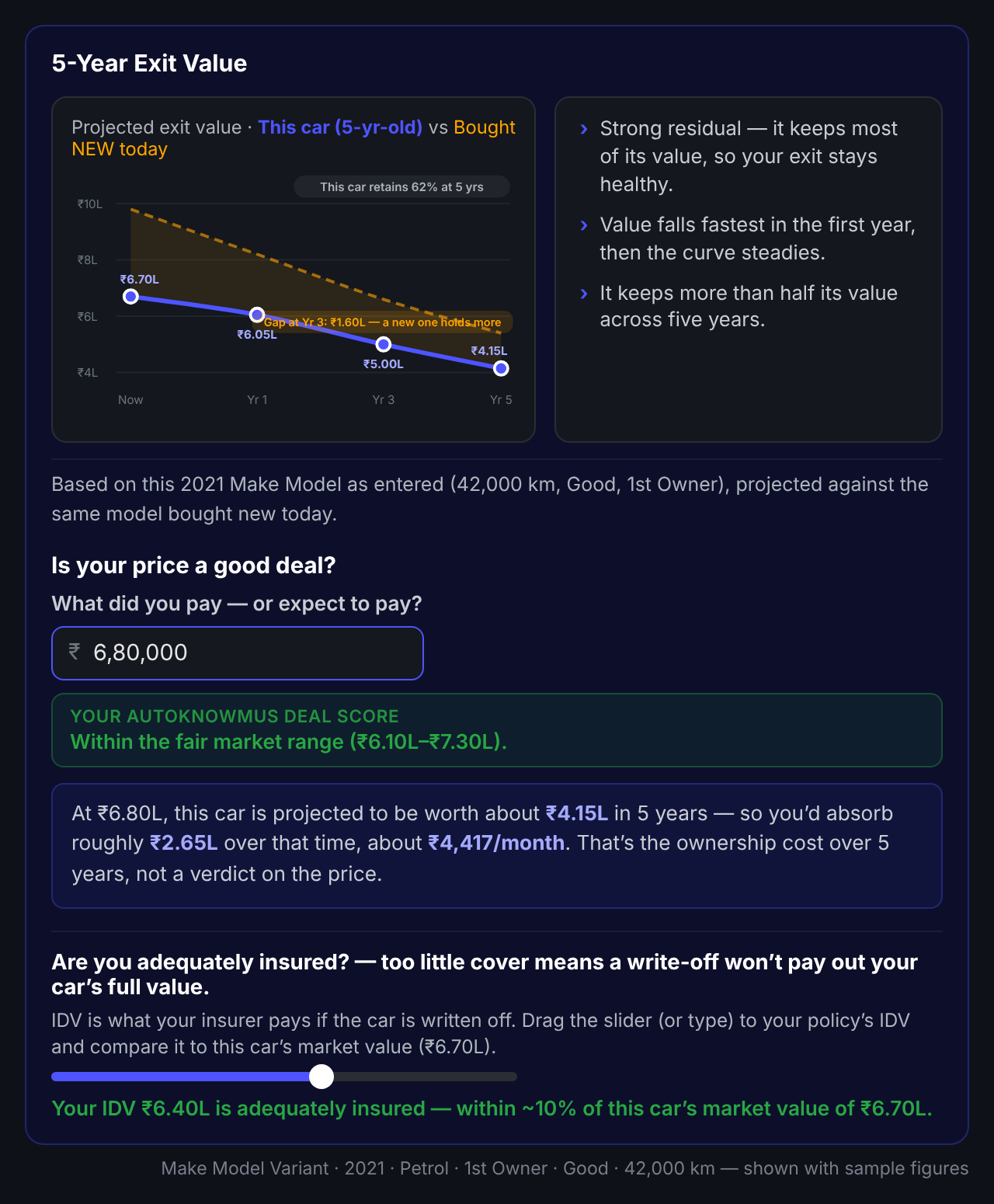
The 5-Year Exit Value on the AutoKnowMus Buyer dashboard, after it is revealed — shown with sample figures for a sample "Make Model Variant".
Let me walk you through it, top to bottom, the way you will see it.
1. The lock — and how to open it. The section is called 5-Year Exit Value. Before you open it, you see a faded sample and a small pill: "Share quick feedback below to unlock." The feedback box sits just above it on your dashboard — tell AutoKnowMus whether the valuation looks right to you. It takes a minute, earns you 50 Credits, and opens the section. Then one button: "Reveal exit value →".
2. The chart. Two lines. The solid indigo line is this car — the one you looked up, with its year, kilometers, condition and owners as you entered them. It shows four points: Now, Yr 1, Yr 3 and Yr 5. The dashed amber line is "Bought NEW today" — the same model bought brand new. The shaded gap between them shows how much more a brand-new one would still be worth at the same point; the dashboard labels it at year three: "Gap at Yr 3: ₹[amount] — a new one holds more." A small pill tells you how much of today's value this car keeps after five years: "This car retains 62% at 5 yrs" in the sample.
3. Three plain lines. Beside the chart, the dashboard tells you in words how this car behaves:
- How strong its residual is — strong ("it keeps most of its value, so your exit stays healthy"), average ("depreciation runs about typical for its class") or weak ("value drains quickly, so the exit will be softer").
- When it loses the most — in the first year, between years 1 and 3, or between years 3 and 5.
- Whether it keeps more or less than half its value across five years.
4. The holding-cost line. For some cars, the dashboard adds one more line: how much the car loses a year at first, how much later, and when "the lowest-cost years to hold" open. If your five years take the car past about eight years of age, it adds a quiet note that "the buyer pool typically thins" — worth factoring into your plans. No hurry word. No sell verdict.
5. The assumption line. Under the chart, one sentence says exactly what was projected: "Based on this [year] [make] [model] as entered ([kilometers] km, [condition], [owner]), projected against the same model bought new today." If what you entered is wrong, the projection is wrong. That line is your reminder.
6. "Is your price a good deal?" Under that heading sits one box: "What did you pay — or expect to pay?" Type the price you expect to pay. Two things appear:
- Your AutoKnowMus Deal Score — where that price sits against the fair market range: within it, below it, or above it, with the percentage. It places the price; it never grades your purchase.
- The ownership cost — the projected value in five years, the amount you would absorb over that time, and roughly how much a month. It ends with the words: "That's the ownership cost over 5 years, not a verdict on the price."
When the saving is thin. If the price you type makes this car cost nearly as much a year to own as a new one, the dashboard adds a line comparing the two over three years: this car's cost a year and a new one's, side by side as two bars, with the difference. It works out each the same way — price minus the projected value after three years, divided by three — and it only appears when this car's yearly cost reaches about 85% of a new one's or more. It does not tell you what to do. It shows you how thin the saving is.
7. Two helpers underneath. An IDV check — slide to your insurance policy's IDV and the dashboard tells you whether your cover sits within about 10% of the car's market value, or is under or over it. And a Loan / EMI calculator — loan, rate and years in, EMI out, or the other way round. Just the arithmetic. No affordability verdict.
Read it as a curve, not a crystal ball
The exit value is projected from today's market for this car. Nobody can promise what a car will fetch in five years — not a Dealer, not a Seller, not AutoKnowMus. What the curve gives you is the shape: how fast this car tends to lose value, when it loses the most, and what that means for your own plan.
Why "ownership cost" changes how you see the price
Here is the eye-opener most Buyers miss.
When you compare two cars, you compare two prices. But the price is only the entry ticket. The real number is price paid minus exit value.
Indigo is what you pay today. Green is what the car is worth when you sell. Amber is what owning it cost you.
That is why two Buyers can pay the same and walk away with very different results. One chose a car that holds its value. The other chose a car that leaks it.
And notice what this does not say. It does not say "buy now" or "wait". It does not say which car is better. It shows you the shape of the cost so you can choose with your eyes open.
Six reasons to look at the exit before you pay
- You see the real cost, not just the price. The ownership cost and the rough monthly figure turn a big number into one you can compare with your budget.
- You can compare two cars fairly. Look up both. The car with the higher price is not always the one that costs more to own.
- You know when the car loses the most. If the steepest drop is behind you, the years ahead are calmer. If it is ahead of you, you know before you pay.
- You can plan your own sale. Knowing how the value moves helps you decide how long you want to keep the car — your call, made with the curve in front of you.
- You check your cover and your loan in the same place. The IDV check tells you if your insurance matches the car's value; the EMI calculator shows what a loan really costs you.
- You earn Credits while you do it. Sharing quick feedback unlocks the section and earns you 50 Credits for your next search. And your honest feedback makes the next valuation — yours or someone else's — a little sharper.
Six questions to ask before you buy for the exit
- What will this car be worth when I sell it? (Look at the Yr 3 and Yr 5 points for this car.)
- Why does it hold or lose value the way it does? (Read the three plain lines.)
- Who will buy it from me? (A car past about eight years of age has fewer Buyers waiting.)
- When do I plan to sell? (Put your own plan on the curve.)
- Where will I sell it — to a Dealer or to another Buyer? (Either way, the paperwork you keep from today travels with the car.)
- How much will owning it cost me? (Type the price you expect to pay and read the ownership cost.)
Six things every good exit plan has
- Price — you know what you are paying, and where it sits in the fair range.
- Projection — you have looked at this car's exit value at one, three and five years.
- Period — you have a rough idea of how long you will keep it.
- Payments — if there is a loan, you know the EMI and the total interest.
- Protection — your insurance cover matches the car's value.
- Paperwork — you will keep every service bill from day one, because the next Buyer will ask.
The exit is mostly in your hands
Here is the part I love telling Buyers. Of the seven things that decide what your car fetches when you sell, six are in your hands:
- You — how you drive it.
- The car — how well you look after it: servicing on time, tyres, small fixes before they grow.
- What goes into it — the parts and fluids your workshop uses.
- Your method — whether you get each problem fixed properly, once.
- Your records — every bill, every service stamp, kept in one folder.
- How you manage it — the right insurance, no long idle months, no surprises at the next RC check.
The seventh — the market — is not in your hands. Demand, new models and new-car prices move on their own. That is exactly why the dashboard shows you the market's side, so you can look after your side.
A car that is well kept, fairly priced on the way in, and sold with a full folder of bills is the car that gets the healthiest exit. That is quality, cost and an easy sale on the day you need it.
Six mistakes Buyers make about resale
- Looking only at the price. Same price, different exit — the cost to own can be very different.
- Treating the projection as a promise. It is a curve from today's market. Use it to plan, not to bet.
- Entering wrong details. Kilometers, owners and condition drive the projection. Check them against the RC and the odometer.
- Throwing away bills. The service folder is part of the exit value. The next Buyer asks for it on day one.
- Ignoring the age you will sell at. Five more years on an older car can take it past the age when the Buyer pool thins.
- Skipping the IDV check. Too little cover means a write-off will not pay out the car's full value.
Your Exit Plan Check
You have seen the curve. Now put your own plan on it.
Tell the check about the car and how you will use it. It shows the age, kilometers and owner count the car will carry on the day you sell it — the same three facts the next Buyer's dashboard will read — and how each would colour on today's "Why is this car priced in this range?" tiles. It never shows a price. Print it, save it as a PDF, or send it on WhatsApp or by email.
Exit Plan Check
Fill it in with your Buyer dashboard open beside it. Nothing is uploaded or saved by AutoKnowMus.
1 · The car today
Owners so far (on the RC)
2 · Your plan
3 · Habits that protect your exit
Show my exit shows your result here and fills the ring. Print or save as PDF opens your phone or computer's print screen — pick "Save as PDF" there to keep a copy. WhatsApp and Email open a ready-made message with your result for you to send. Copy copies it as plain text. Start over clears every field, choice and tick.
The check is a planning aid, not a price and not a prediction. It cannot tell you what the car will be worth — your Buyer dashboard's 5-Year Exit Value shows the projection. Want to check what you actually paid against the fair range? Use the price check at the end of this post.
The short version
| Before you buy a used car | Do this | Not this |
|---|---|---|
| The price | Ask what you pay and what you get back | Stop at the price tag |
| The exit value | Reveal the 5-Year Exit Value for this car | Guess from what a friend got |
| The cost | Read the ownership cost for the price you expect to pay | Compare two cars by price alone |
| The projection | Use it to plan | Treat it as a promise |
| The details | Check kilometers and owners against the RC | Enter what the ad says |
| The habits | Keep every bill from day one | Hunt for bills on the day you sell |
One line holds the whole table together: the price is the entry ticket — the exit decides what the car really cost you.
Why this matters to us at AutoKnowMus
In this trade, the people who buy and sell for a living always priced the exit before the entry. The Buyer at the gate was left to find out the exit years later, on the day they tried to sell.
We built AutoKnowMus to put the same picture in front of everyone: one fair range, the same figure for the Seller and the Buyer, worked out from the car's own facts — make, model, year, variant, owners, kilometers and condition — and blended with verified real deals. Here is how we work it out. The 5-Year Exit Value carries that same market forward for this car, so you can see the cost of owning it before you pay.
We do not buy cars. We do not sell them. We do not list them. Not one rupee of ours moves when your deal closes, whatever price it closes at. The verdict is never for sale.
Know the price. Know the exit. Then buy the car.
FAQs
How do I know the resale value of a used car before buying it?
How much value does a used car lose in five years?
What is the ownership cost of a used car?
Is a used car always cheaper to own than a new one?
How do I unlock the 5-Year Exit Value on AutoKnowMus?
Is it better to buy a newer used car or an older one for resale?
What is IDV and why does it matter for a used car?
Does keeping service records really help resale?
Does the 5-Year Exit Value cost extra on AutoKnowMus?
Before your next visit, look past the price to the exit. Open your Buyer dashboard, look up the car, and reveal its 5-Year Exit Value before you see it.
Next — #04: Who Else Wants It?