To check the fair price of a used car before buying it, look up the car's fair range before you see it — not after you have sat in it. On your AutoKnowMus Buyer dashboard, the top of the screen shows the Estimated Fair Market Value: a range from low to high, worked out from the car's own facts — make, model, year, variant, owners, kilometers and condition — with the Most Likely Value in the middle. Beside it, a five-year Depreciation Forecast shows what the car will be worth in one, three and five years, and how much it will lose each month just by getting older. Enter the Seller's asking price, and if it sits near the top of the range, a warning appears: "Paying top price? Expect steeper loss at resale". Further down, Data Confidence tells you how sure the estimate is. Know the range first. Then go and see the car.
What this post covers
This is the first post in a new series for Buyers — twelve things to do before you buy a used car, in the order they appear on your Buyer dashboard. This one is about the very top of the screen: the fair price. Why it must come before the visit, not after. What each part of the top panel tells you — the range, the Most Likely Value, how the estimate is built, Data Confidence, the five-year forecast and the top-price warning. Six reasons checking first pays you. Six mistakes Buyers make. A Ready-to-Buy Check that tells you whether you are ready to see the car or still researching. And a Price-First Pocket Card to carry into the visit. If you have ever sold a car, twelve things, one verdict shows the Seller's side of the same screen.
It is Sunday morning. 11:20.
You are standing at someone's gate.
The car is parked under a neem tree, washed and shining. The Seller has wiped the dashboard. There is a new air freshener hanging from the mirror.
Your child climbs into the back seat and says, "This one."
Your partner runs a hand along the roof and says, "It looks new."
The Seller smiles and says, "Three people called this morning. One is coming at four."
You ask the price. The Seller tells you.
And here is the strange thing. You have no idea if that number is fair. None. But you are already picturing the first long drive. You are already telling yourself it is about right. You are already a little afraid of the person coming at four.
You have fallen in love with the car.
And you have not yet checked its price.
Love first is the most expensive order
I have been in this trade a long time. I have watched thousands of Buyers walk up to thousands of cars. And the ones who overpay are almost never careless people.
They are people who did things in the wrong order.
They saw the car first. Then they checked the price. And by the time they checked, the decision had already been made somewhere in the chest — so the price check was not a check any more. It was a search for permission.
Think of buying gold.
Nobody sensible walks into a jeweller, tries on a necklace, admires it in the mirror for ten minutes, and then asks what gold costs today. You check the day's gold rate at home. You walk in knowing it. And then, when the necklace is around your neck and the jeweller names a price, you know at once if it is fair or if it is a story.
A used car is the same. Except most Buyers walk in without the day's rate.
The fair price is your gold rate. Read it before you walk through the gate.
Because once the child is in the back seat saying "this one", you are no longer a Buyer weighing a price. You are a parent defending a decision.
The asking price is the Seller's opening line, not the car's price
An asking price is what one Seller hopes to get. It is not what cars like it actually sell for. Some asking prices are fair. Some are hopeful. A few are wildly hopeful. Without a fair range in your pocket, you cannot tell which one you are looking at — and the Seller knows that.
So what exactly should you read before you go? Let us open the top of the Buyer dashboard.
The top of your Buyer dashboard, piece by piece
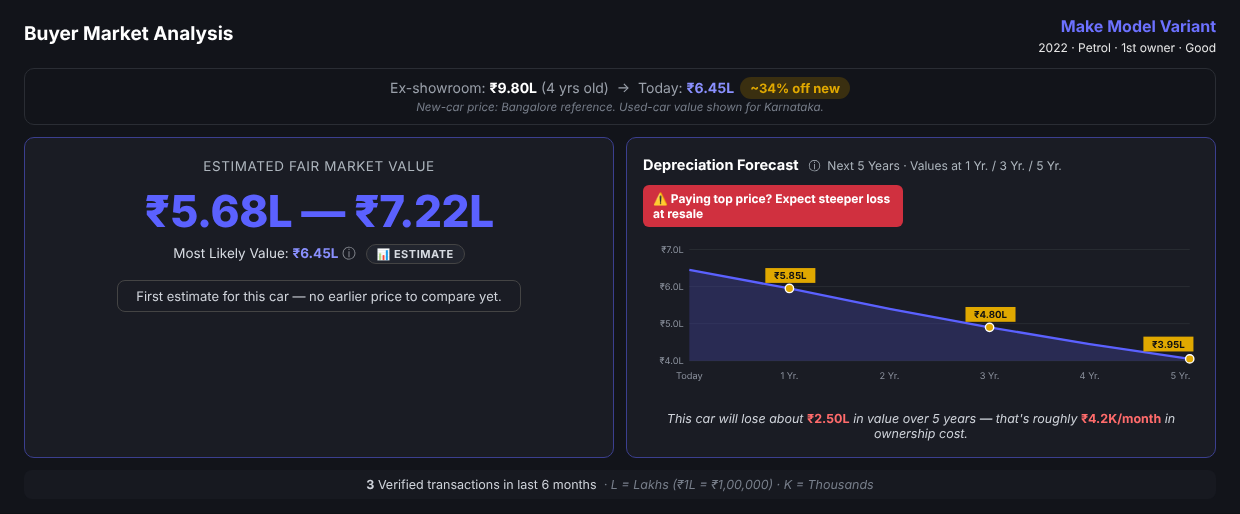
The top of the Buyer dashboard, shown with sample figures for an example car. Your own dashboard shows your car's name and its own figures.
You fill in the car's details — make, fuel, model, variant, year, owners, kilometers and condition. If you have them, you add the Seller's asking price and your own budget. Both are optional. Then you press Analyze Market Intelligence. Here is what lands at the top of the screen, and what to do with each part.
The thin strip at the very top — new against today. It shows what this car cost new, what it is worth today, and roughly how far it has come off its new price. What to do with it: this is your first reality check. It tells you how much of the car's value has already gone — and that the person who bought it new paid for that, not you.
Estimated Fair Market Value — the range. The big numbers: a low and a high. This is the band in which a car with these facts usually changes hands. What to do with it: this is your gold rate. Write both numbers down. Any asking price you hear will now be either inside this band, above it, or suspiciously below it.
Most Likely Value — the middle. Under the range sits one number: the single most likely price for this car. What to do with it: this is where a fair deal tends to land. It is not the lowest you can hope for, and it is not the most you should pay. It is the centre of gravity.
"How this estimate is built" — the small i beside it. Tap it and you see four stages: 📊 Estimate (worked out from age, mileage, condition, ownership and fuel), 📈 Calibrated (blended with early verified deals from the local market), ✓ Market-verified (mostly from real local deals) and ⭐ Real-Market (driven almost entirely by verified transactions). The badge beside the Most Likely Value tells you which stage this car is at. What to do with it: the further along the stages, the more real deals stand behind the number — and the narrower the range gets. At the Estimate stage the range runs about 12% either side of the middle. By the Real-Market stage it tightens to about 5%.
The line under it — has the price moved? The first time you look up a car, it says plainly: "First estimate for this car — no earlier price to compare yet." Save the car to your Garage, check again later, and this line shows Was → Now — the earlier figure, today's figure, and when you last checked. What to do with it: if you are still hunting, this tells you whether waiting has helped you or hurt you.
Depreciation Forecast — the next five years. On the right, a chart shows the car's projected value for the next five years, with values pinned at 1 Yr., 3 Yr. and 5 Yr. Under it, one sentence: "This car will lose about ₹[5-yr loss] in value over 5 years — that's roughly ₹[per month]/month in ownership cost." What to do with it: read that monthly figure out loud. It is a bill you will pay every month you own the car, whether you drive it or not.
"Paying top price? Expect steeper loss at resale" — the warning. This one appears only when you have entered an asking price, and only when that price sits in the top fifth of the fair range or above it. Hover or tap, and it shows what the car may be worth in three years and in five years if you pay that price, and how much you would lose. What to do with it: if it appears, slow down. You are being asked to start your ownership from a higher step — and every rupee of that extra step goes downhill with the car.
"Verified transactions in last 6 months" — the count under it all. A small line under the panel tells you how many verified deals have been reported on AutoKnowMus in the last six months. What to do with it: it is the crowd behind the number. More deals, sharper ranges.
And a few lines further down, in the row of cards, sits Data Confidence — a percentage with a short label. We will come to that in a moment, because it is the piece most Buyers skip and should not.
Why a range, and not one number?
A Buyer once said to me, "Just tell me the price. One number."
I understood. A range feels like someone avoiding the question.
But think of the vegetable market at seven in the morning. Ask ten sellers the price of tomatoes and you will hear a few different numbers. None of them is lying. The tomatoes are a little different. The time of day is different. The stalls are different. There is a fair band — and anything far outside it is either a bargain with a catch or a trick.
Used cars are the same, only more so. Two cars of the same year and variant can differ in a hundred small ways — the tyres, the paint, the bills in the glovebox. A single number would pretend those differences do not exist.
So the range is not the dashboard being vague. The range is the dashboard being honest. And the Most Likely Value tells you where the middle of that honesty sits.
How sure is the number?
Here is the part I wish every Buyer read.
A weather forecast that says "70% chance of rain" is more useful than one that just says "rain". The first one tells you how much to trust it. You carry an umbrella either way — but at 95%, you also cancel the picnic.
Data Confidence on your Buyer dashboard is that percentage for your car's price. Tap the i beside it and you see the ladder it climbs:
95–100% — Highly calibrated due to verified local transactions.
80–94% — Well calibrated due to strong market data availability.
60–79% — Moderately calibrated with available market data.
Below 60% — Pricing model based estimate · Limited market data.
The figure turns green at 80% and above, amber from 60% to 79%, and grey below that. As the card itself says: "Data confidence grows with real transaction data submitted by Sellers & Buyers on AutoKnowMus."
What to do with it: a green figure means you can lean on the range in a negotiation. An amber or grey one means the range is still a strong guide — but your own checks at the visit matter more, and you should keep a little extra room in your plan.
That is not a weakness to hide. It is the dashboard telling you how hard to push.
The meter starts when you drive out
Most Buyers think the cost of a car is the price they pay on the day.
It is not. That is only the entry ticket.
Think of a taxi meter. The moment you sit in and the car moves, the meter starts ticking — slowly, quietly, all the way to your destination. A car you own works the same way. From the day you drive it home, it loses a little value every month. You do not see it. You do not pay it in cash. But you pay it, in full, on the day you sell.
That is what the Depreciation Forecast and its caption are telling you: what the meter will read after five years, and how fast it ticks each month.
And here is the eye-opener most Buyers never see: the meter starts from the price you pay. Pay the top of the range, and you start the ride further up the hill. The car still rolls down at the same pace — but you have further to fall, and more of your money falls with it. That is exactly what the warning "Paying top price? Expect steeper loss at resale" is there to say.
The same four steps, in a different order. The order decides who is in charge — your heart or the market.
Why checking first pays you
This is not about being cautious for the sake of it. Price first pays you, in ways you will feel. Here is how.
1. You walk in with a range, not a feeling. When the Seller names a price, you know in one second where it sits — inside the band, above it, or suspiciously below. No awkward pause. No "let me think about it" that the Seller reads as a yes.
2. You know the real cost, not just the entry ticket. The monthly ownership cost under the chart turns a price into a bill you can plan for. Two cars with the same price can have very different meters.
3. You know how hard you can push. Data Confidence and the stage badge tell you how much weight the range can carry. Green and well along the stages? Stand firm. Grey and at the Estimate stage? Keep some room.
4. You see the top-price trap before you step into it. Enter the asking price, and the warning tells you — before you pay — what that price will cost you at resale in three and five years.
5. You can watch the price instead of guessing. Save the car to your Garage, and when you look it up again later, Was → Now shows whether it has moved. A repeat search of a car already in your Garage costs no Credits.
6. It costs less than the trip to see the car. A Buyer search costs 100 Credits, and new accounts start with 500 Credits — enough to price several cars before you visit any of them.
And there is one more reason, which belongs last: every Buyer who walks in knowing the fair range makes the whole market a little more honest. But you are reading this for your own money first. That is how it should be.
Six questions to answer before you go
Strip any purchase down and six questions are left. Before you drive to see a car, you should be able to answer all six in one line each — and the top of your Buyer dashboard answers every one.
What is it worth? The Estimated Fair Market Value and the Most Likely Value.
Why that much? The car's own facts — make, model, year, variant, owners, kilometers, condition — and the stage that shows how many real deals stand behind it.
Who says so? Not the Seller, not a cousin, not an ad. One fair range, the same figure for the Seller and the Buyer.
When is the number from? Today. And if you saved the car, Was → Now shows how it has moved since you last looked.
Where will it be in five years? The Depreciation Forecast, and the monthly cost of getting there.
How sure is it? Data Confidence, and the ladder behind it.
If any of the six is still a blank, do not go yet. The answer is on the screen.
Six things every good fair price has
Proof — it comes from the car's own facts, not from what someone hopes to get. Precision — a range that narrows as more verified deals are reported. Parity — the same figure for the Seller and the Buyer, so nobody is holding a secret number. Present — it is today's value, and it tells you when it has moved. Projection — it shows where the car's value is heading over the next five years, not only where it is now. Purity — nobody earns more if your deal lands higher or lower.
Six of the seven are in your hands
Here is the part that should calm you down.
Seven things decide whether you pay a fair price for a used car. Six of them are yours.
You — your patience, and your willingness to walk away from a car you like.
The car you choose — there is always another one. The child in the back seat will love the next one too.
The papers — the RC, the insurance, the service record. They tell you whether the kilometers and the number of owners in the ad are true. (No service record in hand? Here is how to check a car's service history for free.)
The method — price first, visit second. Always in that order.
The measurement — the fair range, the Most Likely Value and Data Confidence, read before you go.
The plan — a walk-away price written on paper before you leave home, not decided at the gate.
The seventh is the market — how many Buyers want this car, how many like it are for sale, which way prices are drifting. You cannot change it. But the dashboard shows you exactly what it is doing, so it never ambushes you.
Six of seven in your hands. Most Buyers spend all their worry on the seventh — and leave the other six at home.
Never pay a token on the first visit
"Someone is coming at four" is the oldest line in this trade. Sometimes it is true. Often it is not. Either way, it is designed to make you decide at the gate. A token paid in a hurry is a promise made by your heart. Go home, check the fair range again, sleep on it. A good deal is still a good deal tomorrow morning.
Six mistakes Buyers make with the fair price
I see these every week. Each one costs real money.
1. Checking the price after the visit. By then the heart has voted. The price check becomes a search for permission, not a check.
2. Treating the top of the range as the price. The top of the range is the most a fair deal tends to reach, not where it should start. If the warning appears, believe it.
3. Getting excited about a price far below the range. A price well under the fair band is not luck. It is a question. Why is this car so cheap? Find out before you pay — the answer is usually in the papers.
4. Ignoring the monthly cost. The price is paid once. The meter ticks every month. Two cars at the same price can cost you very different amounts over five years.
5. Skipping Data Confidence. A range with a grey 55% behind it and a range with a green 92% behind it are not the same weapon in a negotiation. Know which one you are holding.
6. Pricing the car you imagine, not the car in front of you. If you entered "Excellent" condition and the car turns out to be "Good", or the kilometers in the ad do not match the dashboard, your range was for a different car. Update the details and look again before you talk money.
Avoid these six, and you are already ahead of most Buyers on the road.
Are you ready to buy — or still researching?
Before you spend a Sunday at someone's gate, be honest with yourself about one thing: do you know enough to say yes to the right car, and no to the wrong one?
Tick what you have actually done — not what you plan to do. The check tells you, in plain words, whether you are ready to go and see the car, almost there, or still researching — and exactly what is left. Then print it, save it as a PDF, or send it on WhatsApp or by email to the person you are buying with.
Ready-to-Buy Check
Tick only what you have already done. The four MUST items decide whether you are ready. Nothing is uploaded or saved by AutoKnowMus.
Check my readiness shows your result here and fills the ring. Print or save as PDF opens your phone or computer's print screen — pick "Save as PDF" there to keep a copy. WhatsApp and Email open a ready-made message with your result for you to send. Copy copies it as plain text. Start over clears every tick and choice.
The check is a planning aid, not a price. It cannot tell you what the car is worth — your Buyer dashboard does that.
If the check says still researching, that is not bad news. It is the cheapest moment to find out — before the drive, before the child in the back seat, before the person "coming at four".
Your Price-First Pocket Card
You are ready. Now put the range in your pocket.
Fill in what your Buyer dashboard told you and what the ad says, and the card turns it into one short note to carry into the visit — how much to trust the range, what the car will cost you each month, what to check at the gate, and the rules you have set for yourself. Copy it and keep it on your phone, or send it to the person coming with you.
Price-First Pocket Card
Fill it in with your Buyer dashboard open beside it, before you go to see the car. Nothing is uploaded or saved by AutoKnowMus.
What your Buyer dashboard told you
What the ad says (you will check these at the visit)
Your rules for the visit
Make my card turns your answers into a short note below. Copy card copies it as plain text, ready to keep on your phone or send on WhatsApp. Start over clears every field, dropdown and tick.
Open my Buyer dashboard takes you to AutoKnowMus to look up the car's fair range. Already bought? takes you to "Just bought or sold a used car?" at the bottom of this page, a quick price check that also records your deal.
The card is a planning aid, not a price. It cannot tell you what the car is worth — your Buyer dashboard does that.
The short version
| Before you buy a used car | Do this | Not this |
|---|---|---|
| The order | Read the fair range, then see the car | See the car, then check the price |
| The asking price | Place it against the range | Take it as the car's price |
| The range | Write down low, high and Most Likely Value | Remember "roughly" |
| Confidence | Know how hard you can push | Skip the percentage |
| The monthly cost | Plan for the meter | Count only the entry ticket |
| The top-price warning | Slow down when it appears | Explain it away |
| Readiness | Run the Ready-to-Buy Check first | Go "just to have a look" |
| The visit | Carry a walk-away price on paper | Decide at the gate |
| "Someone is coming at four" | Go home and sleep on it | Pay a token in a hurry |
One line holds the whole table together: know the number before the car can talk — because once you are in love, every price sounds fair.
Why this matters to us at AutoKnowMus
Buying a used car is one of the few big purchases where the other side almost always knows more than you. The Seller has lived with the car for years. You have met it for fifteen minutes, under a tree, with your family watching.
We built AutoKnowMus to close that gap — one fair range, the same figure for the Seller and the Buyer, worked out from the car's own facts: make, model, year, variant, owners, kilometers and condition, and blended with verified real deals as they are reported. Here is how we work it out. The top of your Buyer dashboard is that range, on your phone, before you leave home.
We do not buy cars. We do not sell them. We do not list them. Not one rupee of ours moves when your deal closes, whatever price it closes at. The verdict is never for sale.
Read the price at home. Meet the car with your eyes open. Fall in love only with a fair deal.
FAQs
How do I check the fair price of a used car before buying?
How do I know if I am ready to buy a used car?
How much should I pay for a second hand car?
How do I avoid overpaying for a used car?
Is the asking price of a used car its real price?
Why is the fair price a range and not one number?
What does Data Confidence mean on the Buyer dashboard?
What happens if I pay the top of the fair range?
How much does a Buyer search cost on AutoKnowMus?
Before your next visit, read the number first. Open your Buyer dashboard, look up the car, run the Ready-to-Buy Check, and write down the range before you see it.
Next — #02: The New One Is Coming.