Before you buy a used car, check whether its model is about to change. On your AutoKnowMus Buyer dashboard, a strip called Model News appears just above the Market Indicators when the carmaker has confirmed something that touches that exact car: a new generation, a refreshed version (a facelift), the model being discontinued, a fuel version being added or dropped, or a change in new-car prices. It shows the fact and its date — for example, that a refreshed version is confirmed with a launch window — and one line for you as a Buyer, such as "Cars like this one become the pre-facelift version from launch." A badge beside the price can read REPLACEMENT CONFIRMED, FACELIFT CONFIRMED or DISCONTINUED, and a dashed amber line marks the launch on the five-year chart. Only confirmed news appears, never rumours. Your fair value stays today's. The decision stays yours.
What this post covers
The second of twelve things to do before you buy a used car. Why the trade hears about a new model long before you do. What the Model News strip on your Buyer dashboard shows, line by line — and what it will never say. The life-stage badge and the launch pin on the five-year chart. Six reasons knowing first pays you. Six mistakes Buyers make around a launch. And a Before-the-New-One Check near the end that you can print, save as a PDF, or send on WhatsApp. If you missed it, price first, love later is where this series began.
It is a Saturday in March. 4:30 in the afternoon.
Three weeks ago, you bought a used car. Clean, one owner, a fair price. You checked everything.
Today your neighbour pulls up in the same model.
Except it is not quite the same.
New lights. A new face. A bigger screen inside. The badge on the back is the same, but everything around it looks a year younger than yours.
"It launched last week," your neighbour says. "Didn't you know?"
You did not know.
The Seller probably did. The Dealer down the road certainly did. The trade magazines had written about it for months.
You were the last person to hear.
And here is what stings. Nothing about your car changed. It drives exactly as it did on the day you bought it. But the day you sell it, the next Buyer will ask one question first: "Is this the old shape?"
The trade hears it first
I have been in this trade a long time. And every single year, I watch the same thing happen.
A carmaker plans a new generation or a refreshed version. The news starts quietly — a launch window, a confirmation from the company, a few reports. Dealers hear it. Brokers hear it. People who buy and sell cars for a living plan their stock around it.
The ordinary Buyer hears it last. Usually from a neighbour. Usually after paying.
Think of the railway platform.
The station master knows the train is late. The tea stall knows. The porters know — they have already sat down. Only the passenger standing at the edge with a heavy bag is still staring down the track, waiting.
Nobody lied to the passenger. Nobody told them either.
Model News is the announcement board on that platform. It does not tell you whether to wait or to leave. It tells you what is coming, and when, so you can decide for yourself.
A launch does not change your car. It changes the room your car stands in.
The engine, the seats and the service history are exactly the same the day after a new version launches. What changes is the comparison. From launch day, every Buyer sees your car next to a newer face. Knowing that before you buy is not about fear. It is about knowing which room you are walking into.
So what exactly does the strip show? Let us open it.
The Model News strip, piece by piece
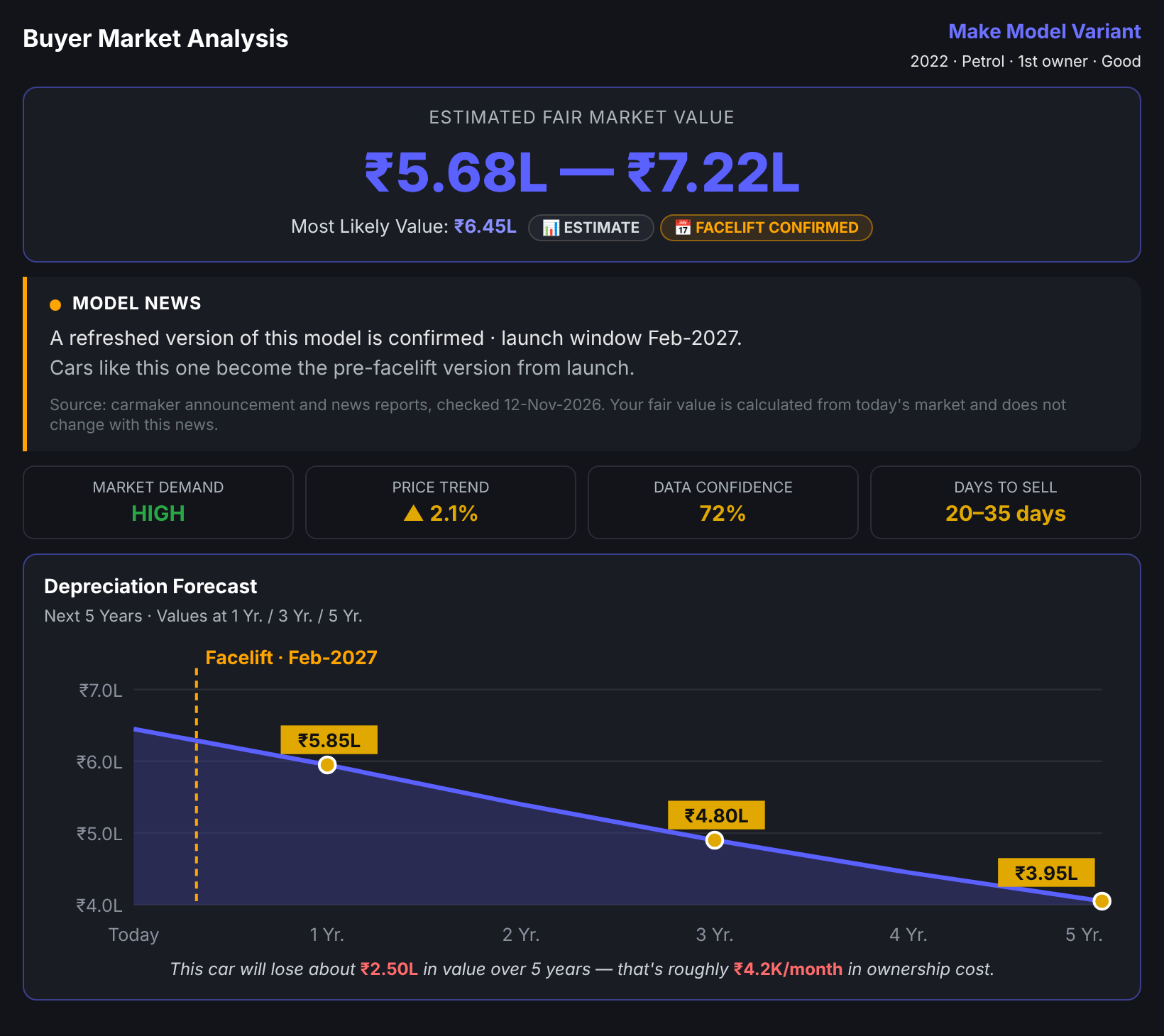
The Model News strip on the Buyer dashboard, shown with sample figures for an example car. On your own dashboard it appears only when confirmed news touches your car.
You look up a car the usual way — make, fuel, model, variant, year, owners, kilometers and condition — and press Analyze Market Intelligence. If there is confirmed news for that car, here is what you see, and what to do with each part.
The amber dot and the label — MODEL NEWS. It sits directly above the Market Indicators. It is not a red alarm and it is not a pop-up. It is a calm, dated note. What to do with it: read it before you read anything else below it. It changes how you read the rest.
The headline — the fact and its date. One sentence, written the same way every time. A new generation of this model is confirmed, with a launch window. A refreshed version of this model is confirmed. This model was discontinued by the carmaker. A fuel version was added or is being dropped. New-car prices went up or down. Once the launch has happened, the words change to launched and the date it happened. What to do with it: note the date. If the carmaker only gave a month, you see a month — never an invented day.
The second line — what it means for you as a Buyer. For a new generation: "From launch, cars like this one become the outgoing generation." For a refreshed version: "Cars like this one become the pre-facelift version from launch." What to do with it: this is the sentence the next Buyer will be thinking when you sell. Read it now, while you can still choose.
The footer — where it came from. "Source: carmaker announcement and news reports, checked" on a date, and then the most important line on the whole strip: "Your fair value is calculated from today's market and does not change with this news." What to do with it: trust the price above it as today's price. The news is a fact about tomorrow. The fair value is a fact about today. They sit side by side, and neither pretends to be the other.
Two more things appear with the strip.
The life-stage badge. Up in the fair value card, beside the Most Likely Value, a small amber badge can read REPLACEMENT CONFIRMED, FACELIFT CONFIRMED or DISCONTINUED. What to do with it: it is the one-word version of the strip. If you screenshot the price, the badge goes with it — so whoever you share it with sees the news too.
The launch pin on the five-year chart. If the launch falls within the five years of the Depreciation Forecast, a dashed amber line marks the spot, with a short label like Facelift · Feb-2027. The curve itself does not bend. What to do with it: look at where the line sits against the years you plan to keep the car. That one glance tells you whether your ownership crosses the launch.
And if there is no confirmed news for your car? There is no strip at all. No empty box. No "nothing to report". Silence means nothing confirmed touches that model, fuel and year right now.
Why only confirmed news?
A Buyer once asked me, "Why don't you show the rumours too? Everyone talks about them."
Because a rumour costs nothing to start in this trade. Every season there is a rumour that a model is changing. Many never happen. Some happen two years later than the rumour said.
If the strip showed rumours, it would frighten Buyers out of good cars every week.
So the rule is strict. For news to reach your screen, it needs two independent sources on two different sites — and at least one of them must be the carmaker's own announcement, or a report quoting it. It must touch the right model, the right fuel and the right years. Rumoured items are kept off the screen until they are confirmed. Cancelled plans disappear.
Think of a doctor's report. A good doctor does not write down every worry you mention in the waiting room. They write what the tests confirm. That is what makes the report worth reading.
Fewer notes, all true, beats many notes you cannot trust.
What the strip will never say
This part matters as much as what it does say.
The strip will never tell you to wait. It will never tell you to hurry. It never says "good time to buy" or "last chance". It never puts a rupee figure or a percentage on what a launch might do to a price.
Why? Because the same news means different things to different Buyers.
For a family that keeps cars for eight years, a facelift next spring may not matter at all. For a Buyer who plans to sell in eighteen months, it may matter a lot. For someone who wants the newest face, it may be a reason to wait. For someone who wants a proven older version at a fair price, it may be the best moment of all.
The strip gives everyone the same fact. You bring the plan.
Put the launch date next to your own date
The question is never "is a new one coming?" A new one is always coming, sooner or later. The question is: does the launch fall inside the years I plan to keep this car? If it does, you will sell into a room where yours is the older face. If it does not, the launch may simply pass you by. The launch pin on the five-year chart answers that in one glance.
The launch date is the same for everyone. Where it lands in your own plan is what makes it matter — or not.
Why knowing first pays you
This is not about being nervous. Knowing the news before you buy pays you, in ways you will feel.
1. You stop being the last to know. The Seller and the trade already know. Now so do you. That alone changes how the conversation feels.
2. You choose with your eyes open. You can still buy the car — many Buyers should. But you choose it knowing it becomes the outgoing generation or the pre-facelift version, instead of finding out from a neighbour.
3. You can ask better questions. Is this car already the refreshed version, or the earlier one? Which month was it registered? Questions like these show the Seller you know what you are buying.
4. You can plan your own exit. If you plan to sell in two years and the launch is next year, you know your resale will happen in a different room. You can plan for that now, not then.
5. You keep your fair value honest. The footer reminds you that today's fair value has not changed. Nobody can use the news to frighten you into paying more, or into paying less than a fair price for the car you actually want.
6. It costs nothing extra. Model News comes with the Buyer search you already run — a Buyer search costs 100 Credits, and new accounts start with 500 Credits. If the strip is there, you see it. If it is not, nothing confirmed touches your car.
And one more reason, which belongs last: every Buyer who knows the dates makes the market a little fairer for the next one. But you are reading this for your own money first.
Six questions to answer before you go
What is changing? A new generation, a facelift, the model ending, a fuel version, or new-car prices.
Why should I care? Because from launch, cars like this one may become the outgoing or pre-facelift version — and the next Buyer will notice.
Who says so? The carmaker, or a report quoting it, plus a second independent source. Never a rumour.
When does it happen? The launch window on the strip — an exact day, a month or a quarter, never invented.
Where does it land in my plan? On the five-year chart, against the years you plan to keep the car.
How do I act on it? Ask the right questions at the visit, decide which version you actually want, and keep your walk-away price where the fair value says it should be.
If you cannot answer all six, look at the strip again before you go.
Six things every good piece of model news has
Proof — the carmaker said it, or a report quoting the carmaker did. Pairs — two independent sources on two different sites, never one voice repeated. Precision — the date is as exact as the carmaker made it, and never more. Particular — it matches this model, this fuel and these years, not "the brand". Plain — one fixed sentence, no adjectives, no drama. Price-neutral — it never moves your fair value and never puts a number on the launch.
Six of the seven are in your hands
Seven things decide how a coming launch affects you. Six of them are yours.
You — whether you want the newest face, or a proven older version at a fair price.
The car you choose — the outgoing version, the refreshed one, or a different model altogether.
The papers — the RC and the registration month tell you exactly which version this car is.
The method — read the strip first, then the price, then visit.
The measurement — the fair value, which stays today's, and the launch date, which stays a fact.
The plan — how many years you will keep the car, and whether the launch falls inside them.
The seventh is the carmaker's calendar. You cannot change it. But the strip shows it to you, dated and confirmed, so it never ambushes you.
Never let "the new one is coming" be used against you
Some people use launch talk to rush you ("buy now, prices will jump") and some use it to scare you ("this car will be worth nothing next year"). Both are trying to move your number. The strip's footer is your answer: the fair value is calculated from today's market and does not change with this news. Talk about the version, the papers and the condition. Keep the price where the fair value puts it.
Six mistakes Buyers make around a launch
I see these every season.
1. Hearing it from a neighbour. The news was public for months. The strip would have shown it on the day you looked the car up.
2. Trusting a rumour. A rumour that never happens can cost you a good car, or a good price. Only confirmed news reaches the strip.
3. Treating a launch as a discount. A launch does not change today's fair value. Anyone who says "knock off a big chunk, the new one is coming" is guessing, not reading the market.
4. Not knowing which version you are buying. If a refreshed version launched last month, some cars on sale are the new face and many are the earlier one. Check the registration month and the details.
5. Ignoring your own exit. The launch only matters if you sell after it. Put the launch pin next to the years you plan to keep the car.
6. Waiting forever. A new one is always coming. If you wait for every launch, you never buy. Know the date, then decide.
Avoid these six, and the launch works for you instead of against you.
Your Before-the-New-One Check
You have seen the strip. Now put it next to your own plan.
Tell the check what your Buyer dashboard showed and how long you plan to keep the car. It shows you, in plain words, whether your ownership crosses the launch, what to ask at the visit, and what to check in the papers. Print it, save it as a PDF, or send it on WhatsApp or by email to the person you are buying with.
Before-the-New-One Check
Fill it in with your Buyer dashboard open beside it. Nothing is uploaded or saved by AutoKnowMus.
1 · What your Buyer dashboard showed
Is there a Model News strip above the Market Indicators?
What does the headline say?
Has it happened yet?
2 · Your own plan
3 · Before the visit
Check my plan shows your result here and fills the ring. Print or save as PDF opens your phone or computer's print screen — pick "Save as PDF" there to keep a copy. WhatsApp and Email open a ready-made message with your result for you to send. Copy copies it as plain text. Start over clears every choice and tick.
The check is a planning aid, not a price and not a prediction. It cannot tell you what the car is worth or what a launch will do — your Buyer dashboard shows the fair value and the dated news.
The short version
| Before you buy a used car | Do this | Not this |
|---|---|---|
| The news | Read the Model News strip first | Hear it from a neighbour |
| Rumours | Ignore them — only confirmed news reaches the strip | Let a rumour decide for you |
| The date | Put the launch next to the years you will keep the car | Panic about "a new one is coming" |
| The version | Check the registration month on the RC | Assume every car on sale is the same |
| The price | Keep it where today's fair value puts it | Let launch talk move your number |
| The decision | Choose the version you actually want | Wait forever for the next launch |
One line holds the whole table together: you cannot stop the new one coming — but you can make sure you are not the last to know.
Why this matters to us at AutoKnowMus
In this trade, news about a coming model has always travelled through the back door first — to the people who buy and sell for a living. The Buyer standing at the gate heard it last.
We built AutoKnowMus to put the same facts in front of everyone at the same time: one fair range, the same figure for the Seller and the Buyer, worked out from the car's own facts — make, model, year, variant, owners, kilometers and condition — and blended with verified real deals. Here is how we work it out. Model News sits beside that range as a dated, confirmed fact, and it never moves the number.
We do not buy cars. We do not sell them. We do not list them. Not one rupee of ours moves when your deal closes, whatever price it closes at. The verdict is never for sale.
Know the date. Keep the fair value. Choose the car you actually want.
FAQs
Should I buy a used car before a new model launches?
What is a facelift in a car?
Does a new model launch reduce the value of my used car?
How do I know if a used car is the old or new version?
Why don't I see Model News for my car?
What does "outgoing generation" mean?
Is it a good idea to buy a discontinued car?
Does Model News cost extra on AutoKnowMus?
Before your next visit, check the calendar as well as the price. Open your Buyer dashboard, look up the car, and read the Model News strip before you see it.
Next — #03: Buy the Exit, Not Just the Car.